
Misc. 1800s Pamphlets and Articles
Mentioning the Spalding-Rigdon Theory
Solomon Spalding mentioned: page 5 Rigdonisms: page 14
|
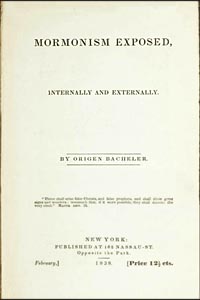
MORMONISM EXPOSED, INTERNALLY AND EXTERNALLY. B Y O R I G E N B A C H E L E R. "There shall arise false Christs, and false prophets, and shall show great signs and wonders; insomuch that, if it were possible, they shall deceive the very elect." MATTH, XXIV. 24. NEW YORK: PUBLISHED AT 162 NASSAU ST. Opposite the Park. February, ] 1838. [Price 12 1/2 cts. |
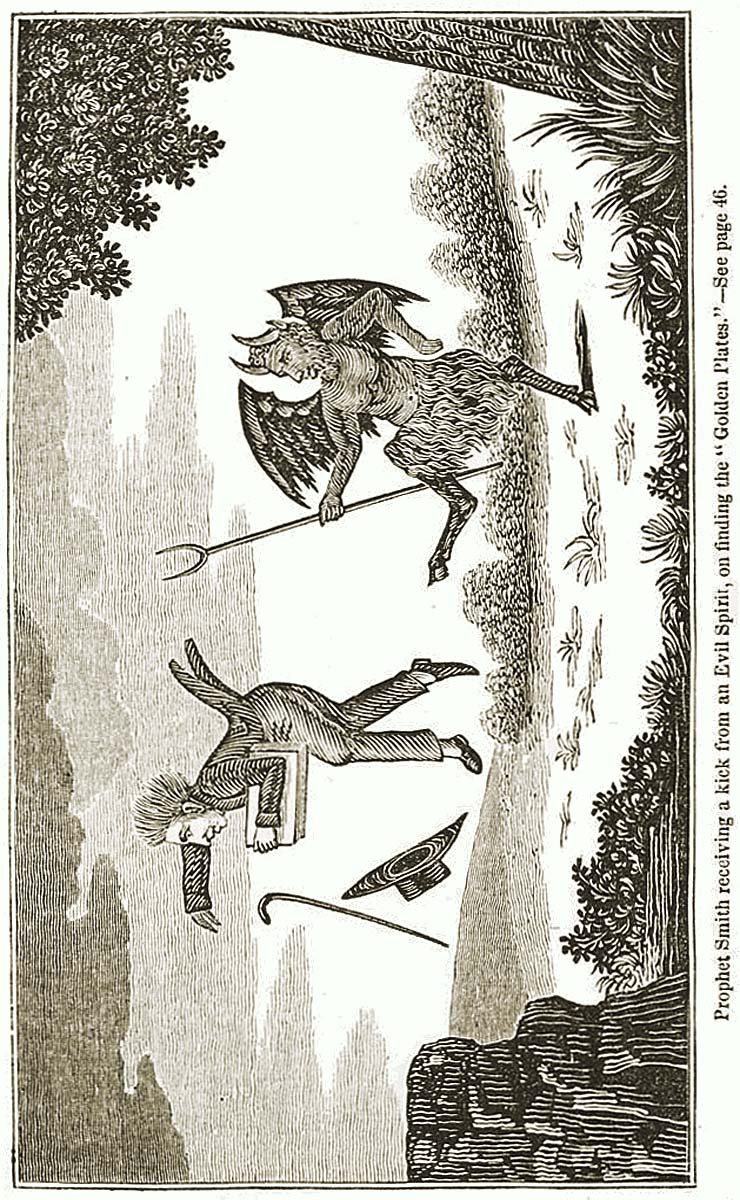
Click on graphic to view higher resolution image. |
|
[4] (Entered according to the act of Congress, in the year 1838, by O R I G E N B A C H E L E R, In the Clerk's Office of the District Court of the Southern District of the State of New York.) [5] MORMONISM EXPOSED. To make an earnest attack on Mormonism, as if it had any plausible pretensions to credibility, would argue great want of discernment and good sense on the part of the one who might thus assail it. It would be somewhat like a labored attempt to disprove the story of Tom Thumb, or like the attack of Don Quixote on the windmill. When Solomon Spaulding wrote the romance entitled "The Manuscript Found," which has since been metamorphosed by Rigdon, Smith, and others into the "Book of Mormon," he merely intended it as a tale, out of the avails of which he hoped to be able to free himself from pecuniary embarrassment; not once dreaming, that a gang of impostors would befool any human beings into the belief of its authenticity -- at least in the present age. And were it not the fact, that some are thus duped, I should deem it altogether a Quixotic undertaking, to spend one moment's time in noticing the affair in the manner I now do. But as some individuals do really assume sober countenances, and are active in endeavoring to proselyte as many as possible to the belief of this fable; and more especially, as they meet with some success among a particular portion of the community, (as all impostors do;) I feel that it would not be a work of supererogation, briefly to expose some of the defects and absurdities of the book under consideration, and to display in bold relief the characters of the miscreants who are battening on the ignorance and credulity of those upon whom they can successfully play off this imposture. It is to "break the snare of the fowler," to dissipate the mists of delusion, to draw the line of demarcation between imposture and truth, and to hold up to merited indignation, before the eyes of an insulted community, perhaps the 6 MORMONISM EXPOSED. most vile, the most impudent, the most impious knot of charlatans and cheats with which any community was ever disgraced and cursed, that I assume my present undertaking. These considerations will, I trust, be deemed sufficient by my fellow-citizens, to justify the course I pursue, in stooping to notice an affair so intrinsically worthless and contemptible as is the Mormon imposture. For some time past, the denizens of our goodly city of Gotham have been vastly edified by the "holdings forth" of a Mormon preacher by the name of Parley P. Pratt. When he came to the city, he succeeded in obtaining the use of a church, by concealing the fact that he was a Mormonite, and calling himself a "Latter Day Saint." This was perfectly in character for a propagator of a religious imposition, and just what might be expected. Mr. Pratt at length began to reveal himself as a Mormon miracle-monger; and by this means, not by any extraordinary abilities, he succeeded in exciting a degree of public attention. Having thus raised the breeze, he now commenced the promulgation of his Mormon fooleries, with regard to the finding of the "Golden Plates" of the "Book of Mormon" by Joseph Smith jr., and all that sort of thing. Indignant at his audacious imposition, I called upon him to submit his Book to the test of public investigation. After some hesitancy, and finding he could offer no satisfactory excuse for declining my proposal, he accepted it. A public discussion was then arranged between him and myself. On the fourth evening of the discussion, this champion of Mormonism, this challenger of all Christendom, signified his intention to retire from the field, under the pretence that I had cast unmerited ridicule on the Mormon Book. I insisted on his remaining. He then appealed to the audience; but they, too, insisted on his continuing. On the sixth evening, no sooner had I begun to touch upon the subject of the credibility of his witnesses, than he raised an objection, and declared that if I persisted in that course, he would withdraw altogether from the debate. I informed him that I should examine the character of those witnesses, as a matter of course. It was then pretended, on the Mormon side, that we had agreed not to examine the external evidences in the case. A greater falsehood than MORMONISM EXPOSED. 7 this was never uttered. But what better can be expected from men engaged in promoting a system of falsehood? Not to examine the external evidences indeed! So foolish a falsehood scarcely needs a contradiction. It carries its own condemnation on its very front. Just as if I would agree not to look into the character of such impostors as Smith, Rigdon, and their kidney. No! Mr. Pratt, previous to the commencement of the discussion, asked me what points of evidence we should examine. "Prove your Book in any way whatever," said I, "whether by itself, or by positive testimony, or by scripture. Prove your Book if you can, by any kind, or by all kinds, of evidence you please. And on my part, I shall disprove it in any way I please." Accordingly, the very first evening of the discussion, he brought forward his positive testimony -- his external evidence -- his witnesses to the divine character of the "Book of Mormon." Yes! he himself brought forward this external evidence -- these witnesses -- declaring at the same time, that their character was unimpeachable. And I must not look into their character, to see whether or not he told the truth, and they were credible witnesses! Fine rule of evidence! fine mode of discussion! -- And because I persisted in my course, and went on examining their credibility, he actually abandoned the discussion! No wonder, however, at this. He could never have kept himself in countenance; it would have made his ears tingle; it would have crimsoned his face with burning blushes, brazen as it is with imposture; had he remained to hear recounted the black deeds of his associate impostors. Of this the reader will be fully convinced, ere he finishes the perusal of this pamphlet. No wonder, then, that Mr. Pratt wished to prevent my examination of the character of his witnesses. This, however, constituted no reason why he should withdraw from the discussion. It was his business to remain, and defend their character, if it was defensible, and by that means preserve his cause from injury. But no. Off he takes himself at the very moment when, of all others, his services were most needed; in the very heat of the battle, when Mormonism was assailed at its vitals. Then it was, that he beat a retreat, and left poor old "Mormon" to take care of himself! 8 MORMONISM EXPOSED. Mr. Pratt having thus retired, in the midst of the investigation, and the audience in general having signified their wish to have me finish it alone, I occupied two evenings more, making eight in all; when I brought the subject to a close. Having premised thus much by way of introduction, I will now proceed to the examination of the subject under consideration; in doing which I must observe great brevity, the materials being so abundant, that to go fully into detail would require a large volume, instead of a pamphlet like this. In treating this subject, the most natural order seems to be, to examine the "Book of Mormon" itself. The "Book of Mormon" says Pratt's "Voice of Warning," "was found in the year of our Lord one thousand, eight hundred, and twenty seven, in Ontario county, New York. It was translated and published in the year of our Lord one thousand, eight hundred, and thirty. It contains the history of the ancient inhabitants of America, who were a branch of the house of Israel, of the tribe of Joseph, of whom the Indians are still a remnant: but the principal nation of them having fallen in battle in the fourth or fifth century, one of their prophets, whose name was Mormon, saw fit to make an abridgment of their history, their prophecies, and their doctrine, which he engraved on Plates; and afterwards being slain, the record fell into the hands of his son Moroni, who being hunted by his enemies, was directed to deposit the Record safely in the earth, with a promise from God that it should be preserved, and should be again be brought to light in the latter days, by means of a Gentile nation, who should possess the land. This deposite was made about the year four hundred and twenty, on a hill then called Cumora, now in Ontario county, where it was preserved in safety, until it was brought to light by no less than the ministry of angels, and translated by inspiration. And the Great Jehovah bore record of the same to chosen witnesses, who declare it to the world." Well, friend Pratt, we have heard your statement; but how can we know that these things are so? Any impostor can say as much as this; and other impostors can be MORMONISM EXPOSED. 9 found by scores and hundreds, to swear to any thing he may say. How then can we know that your witnesses testify the truth? "Why," says Mr. Pratt, "I am acquainted with them, and know them to be men of unimpeachable character." Aye, but who are you yourself, Mr. Pratt? You are a stranger to us. How, therefore, do we know even that you speak the truth? To be sure, you have a very demure countenance; you are quite moderate in your manner of speech; and you appear very cool and self-possessed. But now, hear what the author of Lacon, that acute observer of men and things, remarks on this point. "Always suspect a man," says he, "who affects great softness of manner, an unruffled evenness of temper, and an enunciation studied, slow, and deliberate. These things are all unnatural, and bespeak a degree of mental discipline into which he that has no purposes of craft or design to answer, cannot submit to drill himself. The most successful knaves are of this description; as smooth as razors dipped in oil, and as sharp. They affect the innocence of the dove, which they have not, in order to hide the cunning of the serpent, which they have." So then, friend Pratt, we cannot take your word as evidence, till we know something more concerning you -- nor the word of your witnesses, till we ascertain more respecting them. Thus far, you give us no evidence which any impostor cannot give; none that many impostors have not actually given. Nay, some impositions have had a hundred times the evidence that you have yet given. Let us see a few of your miracles, and then we will think a little further on the matter. No miracles, however, make their appearance, although we hear some of your followers testifying to them. So did the French Prophets, and various other impostors. Thus you see again, you do not furnish the necessary evidence -- the evidence requisite to distinguish truth from imposture. What next is to be done? No stir having previously been made in the place, on the subject of Mormonism, the people are uninformed with regard to the character of the propagators of the scheme, and that subject is laid aside for the time being. The Book itself now comes forth, and is offered for sale. But it is the second edition, and is issued by 10 MORMONISM EXPOSED. Messrs. Pratt and Goodson, and purports to have been translated by Joseph Smith, jr. Well, now, Mr. Pratt, is this just like the first edition? "O! Yes," says Mr. P. "excepting typographical errors, such as mistakes in spelling, and the like." On examination of the first edition, however, we find Joseph Smith, jr. denominated the Author. What say to that. Excuse my poetry. I have caught the inspiration of Mormonism already. But seriously, Mr. Pratt, what have you to say as to Joseph Smith's being called the author of the "Book of Mormon" -- and likewise as to your assertion, that the two editions were alike, excepting typographical errors. A strange typographical error indeed, to make Joseph Smith jr., the author, instead of the translator. But now, let us look a little into your Book, (second edition,) and see whether it appears like inspiration internally. This Book, if we may credit the title-page, was not only written, but translated by inspiration. There is therefore no excuse for any blemish whatever in the Book, as it lies before us in its English dress. It is bound to have every thing just as it should be; and a single defect is sufficient to destroy its pretensions. The Bible, making no pretensions to inspired translation, may have defects of certain kinds in the translated copies, without impairing its claims to divine authority; but there is no such excuse for the "Book of Mormon." It must be perfect in every point of view, or its fate is at once and for ever sealed. Now let us see how this matter stands. "To come forth in due time by way of Gentile." Title-page. "By way of Gentile." Such a half-witted barbarism inspiration? Abominable! And a fellow that had neither learning, nor sense, nor "inspiration", nor anything else sufficient to enable him properly to express an idea in his own tongue, pretending that he could translate what no other one could! "And now if there are faults, they are the mistakes of men." Title-page. What do you mean by this? Written and translated by inspiration, and yet talk of faults! Verily, you hav'n't sense enough to conceal your imposition. You are simpletons as well as knaves, and are decidedly beneath MORMONISM EXPOSED. 11 contempt. So much for your title page -- - although I have not noticed have of the ridiculous trash which I find upon it. THE FIRST BOOK OF NEPHI. Chapter and Contents. Written and translated by inspiration, mind ye. O yes! divided into chapters, with a table of contents, by inspirations! The ignorant forger, in attempting to imitate the Bible, seems not to have known, that the division into chapters is a modern invention, and that the tables of contents are no part of the Bible, but are inserted or omitted at the option of the publisher of any edition. So he makes his "Nephi" attach a table of contents to his chapter, as long ago as the capture of Jerusalem by Nebuchadnezzar -- and makes him also say in the same table of contents, "I, Nephi, wrote this record"; thus showing that the contents were to be considered Nephi's."Lehi," the father of "Nephi," is represented as a Jewish prophet. Now ask the Jews if they ever had such a prophet; and they are quite as likely to know, as the juggling, moneydigging, fortune-telling impostor, Smith. This "Lehi," it seems, was of the tribe of Joseph, and dwelt at Jerusalem. The tribe of Joseph at Jerusalem! Go, study scripture-geography, ye ignorant fellows, before you send out another imposition, and make no more such foolish blunders. Lehi finally fled from Jerusalem, to escape the impending destruction by Nebuchadnezzar, and left his gold and silver behind. Rather singular -- and still more so, that it was all safe when he sent back after it. Nephi says, (page 10,) that his father's family consisted of his mother, Sariah, and his elder brothers, who were Laman, Lemuel, and Sam! So then, Nephi himself was not one of his father's children, and one of his brothers was a real Yankee -- Sam! Well done, Prophet Smith; you can't get rid of your Jonathanisms. Sam indeed! Fie, Joseph, how you forget yourself. Can't you forge better than this? Precious little of the Yankee wit, have you in your composition, to let a Yankeeism creep into the ancient "Book of Nephi" in this manner. 12 MORMONISM EXPOSED. On the same page, "Nephi" speaks of a river's running into a fountain. Inspiration with a witness! a river running into a fountain! "And it came to pass -- and it came to pass -- and it came to pass" -- three times in a paragraph of eight lines and one word. A ridiculous attempt to imitate ancient Scripture style -- and a complete abortion. This is but a specimen of the style of the work throughout. But I perceive I am expanding too much for a small pamphlet. So abundant are my materials, that it will be difficult for me to compress them sufficiently to give even the pith of the whole. This must be my apology for the very concise and summary process which I shall adopt for the remainder of the pamphlet. I will now throw a few of the various beauties and excellencies of the "Book of Mormon" into groups, each group under an appropriate head, and let these serve as specimens of the whole. And first I will note a few of the violations of the King's English. BARBARISMS. "They durst not utter against him." Page 10. Utter what, pray? If you utter, you utter something."And it had came to pass." 16. "They did rebel against I, Nephi, and Sam," 19. How beautiful! "Thou art mine elder brethren." "That I might engraven." "For I had spake." "The Lord said unto me, thou shalt engraven," &c. 79. "Bloodsheds." 81. "It supposeth me." 134, 399, 403. "We labour diligently to engraven these words upon plates." 138. "With our mights." 146. See likewise three places, page 147. "He had somewhat contentions among his own people." page 162. "With all your whole soul." 168. "A shepherd art calling." 250. MORMONISM EXPOSED. 13 "They were exceeding fraid." 361. See likewise 374, 414, and 438. "They sleepeth." 401. "I am Jesus Christ, of whom the prophets testified shall come into the world." 503. "The whole human family of Adam." 553. What other family had Adam besides the human family? "They done all these things." 587. "And when these things come, bringeth to pass the scripture which saith." 598. What bringeth to pass the scripture? Nothing, if we go by this writer of semi-ideas in the "Book of Mormon." The foregoing samples are probably not a hundredth part of the gross violations of the propriety of language, that are to be found in the "Book of Mormon." Words and modes of expression are put into the mouth of the Deity, of Jesus Christ, of angels, and of prophets, that would befit only the most vulgar ignoramus. If this is not a degradation of things sacred, an impeachment of the intellectual perfection of Omniscience, it would be difficult to say what would be so. We find no such barbarisms in the Bible, even in the uninspired translation; and Mr. Pratt's attempt, in the discussion, to bring forward a parallel from that book, was a complete failure, and proved his own ignorance of the rudiments of the English Language. As an offset to these and many other barbarisms, he produced from scripture, this sentence, "Thou art IT," &c. The word IT he seemed to think very much out of order. What is the matter with it? Nothing at all; and he who supposes there is, thereby manifests his own ignorance. And yet, this Mr. Pratt, who thus exposed his ignorance of his mother tongue, really talked of my ignorance, and attempted a display of intelligence on general and theological subjects. Yes, this very individual, who cannot write a sentence of correct English, except by chance, and who, in his conversation and public speaking, is continually murdering the language, and exhibiting the most unpardonable ignorance for a public teacher, talks of the ignorance of those who can teach him his alphabet on any subject -- except that of religious imposture -- and assumes to instruct all Christendom in Biblical lore! Really, 14 MORMONISM EXPOSED. he reminds me of an anecdote of a fellow who set up as a preacher, but who was unable to read. When some one inquired of him how he could manage to preach, without being able to read the Bible, he replied: -- "Mother reads, and I spounds and splains." So with Mr. Pratt: he can't read very well; but he is a wonderful spounder and splainer. Let that, however, pass. OTHER VERBALISMS. "Sam, Josh, and Gid." 10, 390, 411, and 499. There's Yankee for ye. Rather out of place, however, in ancient writings; and not to be offset with "Dan and Gad" from the Bible, as Mr. Pratt attempted to do, merely because those names are words of one syllable. Dan and Gad are whole names, and have their distinct significations. Sam, Josh and Gid, are half names, or Jonathanisms."The land of Jerusalem." 10. There is no such land. No part of Palestine bears the name of Jerusalem, except the city itself. "Irreantum, which being interpreted, is, many waters." 46. Proof of this, Mr. Nephi Mormon Moroni Rigdon Harris Cowdery Smith. Let us have the proof. Irreantum signifies a complete ass, nearer than any thing else. "The Devil of all devils." 87. A Rigdonism. "Now these are the words; and ye may liken them unto you, and unto all men." 92. "Ye may liken them unto you." What does this mean? There is no sense in it. It is therefore nonsense. But nonsense is not inspiration. "Ye wear stiff necks and high heads." 134. Wear necks and heads! A curious kind of stocks and hats, to be sure. Genuine Mormon manufacture. "Tame Fruit." Why, of course; why not tame fruit, as well as tame animals. Can't you put fetters on wild fruit, and tame it? A seer and a prophet different. 184. Really! well, these Mormonites are too learned for dictionaries and other books -- more particularly for the Bible. "Neas and sheum." 186. Pray tell me what kinds of grain neas and sheum are. Joseph Smith's translation needs another translation, to render it intelligible. MORMONISM EXPOSED. 15 "A fifth part of their ziff." 189. And what kind of metal is ziff! Come, Joseph, on with thy goggles, and translate thy translation, and tell us what ziff means. "The resurrection shall come forth." 200. "They scourged his skin with faggots." 203. Just look into the dictionary, and see what the word faggot means. The Nephite coin. The golden -- a senine, a seon, a shum, a linnah, an antion, a shublon. The silver -- a senum, an amnor, an ezrom, an onti, a shiblon, a shiblum, a leah. 267, 268. This gibberish, and that of the neas, sheum, and ziff, as above, will do very well to be placed alongside of the "new tongues" of the Mormonites, the jabber of Miss Carraboo, and Sheridan's Greek. "My brothers and my brethren." 313. "My heart is brim with joy." 313. "Rameumpton, the Holy Stand." 330. A pulpit, then, is a Rameumpton. Pray tell us to what language Rameumpton belongs. "It supposeth me, " that it must be a Carraboo term, the same as neas, sheum, and the others. "Acknowledge your faults, and retain that wrong which ye have done." 352. What does this mean? "Retain that wrong." this needs a little Mormon spounding and splaining. "The hand of Providence hath smiled upon you most pleasingly." 134. Who ever before heard of a hand smiling? and then it smiled most pleasingly. O! subleemity. "The enormity of their number." 392. See likewise 409. Enormity signifies great wickedness. Thus: a very wicked number. What a blue idea. a wicked NUMBER! Mormon ERUDITION! "I am consigned, that these are my days." 450. More spounding and splaining needed here. "When ye shall be removed from overshadowing you." 445. Here also. "The battle of the battle." 486. And here. "The pestilence of the sword." 461. And here. "Great infinite." 463. "The Devil laugheth," &c. 498. Quite funny. "And Jesus said unto them, pray on. Nevertheless they did not cease to pray." 522. 16 MORMONISM EXPOSED. "And thus did the thirty and eighth year pass away, and also the thirty and ninth, and the forty and first, and the forty and second; yea, even until forty and nine years had passed away, and also the fifty and first, and the fifty and second." 542. So then the fortieth and fiftieth years are no years at all! Actually, these "getters up" of Mormonism seem not to know how to count. "There were no robbers, nor murderers, neither were there Lamanites, or any manner of ites." 543. Written and translated by inspiration, no doubt. Ites. Think of that. Ites. Aye, ites. Only think of it. Ites. Who can any longer doubt that the "Book of Mormon" is very ancient, and that it was written, and has been translated, by inspiration? "Why have ye transfigured the holy word of God?" 563. Now just look into the dictionary, and see what transfigure means. To impute such vulgarity, such imbecility, such ridiculous nonsense as the foregoing to inspiration, argues a degree of depravity in the impostors who have been the means of sending the trash into the world, that is seldom equalled indeed. It is quite too bad, to represent the Deity as uttering and inspiring gross barbarisms -- language of the most clownish and vulgar description. But when it comes to this, that drivelling, and nonsense such as have just been considered, are attributed to inspiration, it is religious trifling no longer: it is absolute blasphemy. MODERNISMS. A modern work can be made in some measure to resemble antique style; but no ancient work can contain modernisms. A work claiming antiquity, and at the same time abounding with modes of expression, and with circumstances, peculiar to modern times, may without hesitation be pronounced a modern, and a very shallow forgery. For instance: suppose a book should make its appearance pretending to have been written thousands of years ago, which should contain a description of steamboats and railroads,MORMONISM EXPOSED. 17 and be written in the current style of the present day; who would hesitate to pronounce it an impudent, foolish forgery. No man of common sense. Now, then, let us see how the "Book of Mormon," stands this test. "A visionary man." 16. "The Five Books of Moses." 17. "The days of your probation." 26. "The driven snow." 27. Shakspeare. "The compass." 52. "The cold and silent grave, from whence no traveller can return." 65. "I am desirous for the welfare of your souls." 79. "That ye may praise him through grace divine." 92. "I glory in my Jesus, for he hath redeemed my soul from hell." 130. Words put into the mouth of "Nephi," five or six hundred years before Christ. "In a state of never ending happiness." 170. "Your own nothingness." 174. "And they would not be baptized, neither would they join the church." 222. A hundred years before the Christian era! "Scalping." "A spark of freedom." 420. "Rations." 401. "Modern astronomical ideas." 465. "That they might have been clasped in the arms of Jesus." 556. If the preceding modernisms do not prove the "Book of Mormon" a modern work, no work can be proved modern by its style and circumstances, and no modern forgery claiming to be an ancient work can be detected, on account of any modernisms which it may contain. IMPROBABILITIES. To speak in general terms, the whole concern of Mormonism is improbable. But there are portions of the Book that are highly improbable in themselves considered, a few of which I will notice.What can be more improbable, than that the Jews ever had any such prophets as Lehi, Zenock, Neum, Zenos, and 18 MORMONISM EXPOSED. Ezias? See pages 9, 55, and 454. No such prophets are mentioned in the Jewish records. Has money-digger Smith a better list of the Jewish prophets than the Jews themselves have? What can be more improbable, than that Lehi would leave his gold and silver behind, when he set out on his emigrating expedition to America; and likewise, that when he some time after sent back after them, they were perfectly safe? See pages 9 and 13. What can be more improbable, than that Laban's servant should mistake Nephi for his master, merely because he had clothed himself in Laban's garments; and that the servant could not discover a difference in the countenance, the manner, the voice, or the circumstances in any respect, notwithstanding a long conversation in relation to Laban's concerns and other matters. See page 15. Is it probable, that the patriarch Joseph uttered an important prediction in relation to his posterity and Joseph Smith jr. and Sidney Rigdon, of which the Jews know nothing? See page 71. Is it probable, that the Christian church and its ordinances were established, that its members were called Christians, and that miracles were performed in Christ's name on the American continent, long before Christ came? See pages 126, 127, 129, 132, 139, 204, 221, 222, 253, 371 Is it at all probable that God would adopt a course in relation to this subject in America, so contrary to that which he pursued among the Jews in Palestine? "And he shall be called Jesus Christ, the Son of God -- and his mother shall be called Mary." 170, 171. Is it probable that a prediction in relation to Christ should have been made in America, so much plainer than predictions made by the Old Testament prophets among the Jews? Is it probable, that the manner of baptizing would be particularly specified in America, viz. that the administrator and candidate should go down, and stand in the water, and the latter be buried or immersed in the water; and that this manner would be thus specified, to forestal disputations concerning baptism prior to their existence; when no such particularity was observed by Christ in commissioning his Apostles in Palestine to baptize? See pages 204, 504. MORMONISM EXPOSED. 19 Is it probable, that there was a prophet among the Nephites by the name of Samuel, whom they could not hit with stones and arrows; when none of the prophets nor Apostles of Palestine, nor even Christ himself, were thus screened from the assaults of enemies? See pages 474, 475. Is it probable, that when Christ was born, the inhabitants of America were notified of it by a supernatural light, insomuch that it was a light as noon-day during a whole night; and that, at the time of his death, they were notified of that event by such a tempest as never had before been known; that "many great and notable cities were sunk, and many were burned, and many were shaken till the buildings thereof had fallen to the earth; that some individuals were carried away in the whirlwind, and whither they went no man knoweth, save they know that they were carried away," that "there was thick darkness upon all the face of the land, insomuch that the inhabitants thereof who had not fallen could feel the vapour of darkness, and there could be no light because of the darkness, neither candles, neither torches, neither could there be fire kindled with their fine and exceeding dry wood, so that there could not be any light at all; * and there was not any light seen, neither fire, nor glimmer, neither the sun, nor the moon, nor the stars, for so great were the mists of darkness which were which were upon the face the land. And it came to pass that it did last for the space of three days, that there was no light seen." See pages 478, 496, 497. I ask if it is at all probable, that events occurred in America at the birth and death of Christ, so much more wonderful than those in the very country where he was born, and where he died? Is it probable, that as long ago as the time of Christ, and even before, there was in America a Republic much like our own? See pages 371, 373, 419, 420. Is it probable, that God made such a revelation in America as the following, while he said nothing on the subject among Christians in the East: -- "Behold I say unto you, that he that supposeth that little children need baptism, is __________ * What a lying ignoramus! In such a state of the atmosphere as this, where lights and fire wouldn't burn, men couldn't breathe. 20 MORMONISM EXPOSED. in the gall of bitterness, and in the bonds of iniquity; for he hath neither faith, nor hope, nor charity; wherefore, should he be cut off while in the thought, he must go down to hell. -- Wo unto such, for they are in danger of death, hell, and an endless torment. I speak it boldly; God hath commanded me." Epistle of "Mormon" to his son "Moroni," about "four hundred years after Christ," pages 613, 614. When I brought the foregoing passage of the "Book of Mormon" into view, at the time of my discussion with Mr. Pratt, he seemed not a little fearful that it would excite the indignation of the Pedobaptists who were present against Mormonism. So he undertook to soften it down by saying, that it was meant for those only who had great light on the subject, like the churches of that country in those days! Just as if those who have the New Testament, containing the life and doctrines of Christ, and the writings of the Apostles, have not as much light on Christian duties, as juggler Smith can give through his pretended "Book of Mormon." Thus we perceive, that if we regard merely the improbabilities contained in the Book, of which the foregoing samples are but a few, it is totally unworthy of belief. It has the air of falsehood throughout. It has no appearance of truth. It seems just as a forgery would seem, and has not one redeeming trait in this respect to counterbalance. If such a work is not a forgery, then the landmarks of evidence fail, and we have no means of this nature for detecting forgery, and discriminating between falsehood and truth. ABSURDITIES. Nephi creeps into Jerusalem by night. 14. How did he get through the city gate?"I beheld wars, and rumors of wars." 29. Beheld rumors! When the company of emigrants from Jerusalem, headed by Lehi, arrived in America, it is stated that they found the forests stocked with beasts of every kind, among which was the ox! 53. Think of that: -- a natural, forest ox. "Now it came to pass, that Alma took Helam, he being one of the first, and went and stood forth in the water, and MORMONISM EXPOSED. 21 cried, saying," &c. "And after Alma had said these words, both Alma and Helam were buried in the water; and they arose,"&c. "And again, Alma took another, and went forth a second time into the water, and baptized him according to the first, only he did not bury himself in the water." 204, 205. A new way of baptizing indeed, for the administrator to bury himself with the candidate. The "Book of Mormon" represents the Christian church, with all its ordinances, baptism, the Lord's supper, the imposition of hands, and so on, as having been established in America long before the coming of Christ! It likewise represents the law of Moses to have been obligatory at the same time! 312, 370, and various other places. "And the angel spake more things unto me, which were heard by my brethren, but I did not hear them." 343. The "Book of Mormon" states, that Christ appeared to the inhabitants of this continent after his resurrection, and not only exhibited his pierced side, as he did to Thomas, but that the multitude actually thrust their hands into it." 503. * * * * * * * * This beats Gulliver, and every body else. "And behold he" (Jesus) "prayed unto the Father, and the things which he prayed cannot be written, and the multitude did bear record who heard him." 516. Why cannot the things which he prayed, and which the multitude heard, be written? The "Book of Mormon" represents Christ as having chosen twelve American Apostles. 520. For what purpose, pray. The twelve Apostles in Palestine were to judge the twelve tribes of Israel, &c. Why then choose twelve American Apostles? The "Book of Mormon" says, that a company emigrated to America soon after the confusion of tongues at Babel; and that they took with them not only the fowls of the air, and various kinds of creatures, male and female, but even "the fish of the waters." 570. How provident! to carry fishes across the ocean! Think they took along with them any bottles of air? The leader of this company of emigrants, was, it seems, one Jared. This Jared had a brother who could work miracles "just as easy as nothing." Don't you think, "he 22 MORMONISM EXPOSED. said unto the mountain Zerin, �Remove!' and it was removed." I DECLARE! I never heard anything like it, except the Hindoo miracle of Vishnoo, who, it is said, drank a sea dry. What objects were accomplished by these miracles, does not appear. Perhaps Vishnoo wrought his to slake his thirst; and Jared's brother his, because he "took a notion to." "The brother of Jared went forth unto the mount -- and did moulten out of a rock sixteen small stones." 573. To say nothing of the barbarism, "did moulten," just consider the idea. What does the term moulten (properly spelt molten,) mean? Why, melt. So Jared's brother, according to this passage, melted sixteen stones out of a rock! But the "beat all" remains to be told. It seems there was, on this continent, long prior to the Christian era, so immense a population, that a single monarch by the name of "Coriantumr," after having lost in one war "two millions of mighty men, and also their wives and children," making in all something like eight or ten millions, succeeded in collecting another army, composed of men, women, and children, all "armed with weapons of war, having shields, and breastplates, and headplates." This army met another of the same description, under "Shiz." Well, at it they went; and after fighting days and days, they completely annihilated each other. Not a soul was left on either side. "Coriantumr" and "Shiz" were the last, and they killed each other. There is no parallel for this in all history, excepting the battle of the Kilkenny cats, which was terminated by their eating one another entirely up, insomuch that not a single tip of a tail of any of them remained. To put forth such absurdity as the foregoing, even in a novel, would ruin the work, because it is untrue to nature, and befits only those monstrous productions called "Stories for Children," such as Fairy Tales, Little Red Riding Hood, and the like. But that it should be presented to the world as a matter of faith, and that any could be found who would actually believe it, is more wonderful than would be the occurrence of the events themselves. If absurdities like these can be believed, what is there too absurd for belief and why not believe every extravagant tale that any impostor may choose to utter?
MORMONISM EXPOSED.
23
Before I proceed to give specimens of contradictions of scripture, as contained in the "Book of Mormon," it is proper to state, that it is a standing rule with the Mormonites, that the Bible is not a safe guide as it now exists. Ezra Booth, a Methodist clergyman, who was an early convert to Mormonism, but who renounced it on discovering its nature and design, says, in one of a series of letters addressed to a presiding Elder, dated Nelson, Portage Co., Sept. 1831, that the Mormon "revelations entirely supersede the Bible; and in fact, the Bible is declared too defective to be trusted in its present form, and it is designed that it shall undergo a thorough alteration, or, as they say, translation. This work is now in operation. -- It was intended to have kept it a profound secret, and strict commandments were given for that purpose." The reader will get an idea of the character of this altered Bible, from what Mr. Booth states in another of his letters. Speaking of Joseph Smith Jr. he says: -- "In translating, the subject stands before his eyes in print, but it matters not whether his eyes are open or shut; he can see as well the one way as the other." So it appears, that this Mormon alteration of the Bible is not made by means of a critical examination 24 MORMONISM EXPOSED. of the original, according to the established rules of language; but by Smith's inspiration. No regard is paid to the original; Smith tells, not what it is, but what it ought to be. The Mormon edition of the Bible, therefore, is not a new translation, but a new revelation -- another gospel. Hence, as might be expected, Mormonism abounds with contradictions of scripture, and is in one sense a system of infidelity. It is a very common thing to hear its preachers, who know nothing of Hebrew or Greek, and very little of English, pronouncing such and such a passage erroneous, and telling how it should be. I find in Pratt's "Voice of Warning," page 152, an instance of this alteration or contradiction of scripture, as follows: -- "It repented Noah that God had made man, and it grieved him at his heart." This is the manner in which these Mormonites treat scripture; and what do infidels more? Let us now consider a few instances of the contradiction of scripture by the book itself. "If Adam had not transgressed, they (Adam and Eve) would have had no children." 69. Now the Bible says, Gen. i. 27, 28, "God created man in his own image; in the image of God created he him; male and female created he them." Why male and female? What says common sense? Aye, and what says scripture too. Look. "And God blessed them, and God said unto them, Be fruitful, and multiply, and replenish the earth." All this before man fell. And yet, "they would have had no children, had they not fallen," saith the "Book of Mormon." "They had no blood in them, and couldn't have children before the fall," saith Mr. Philosopher Pratt. How sage! Friend Pratt should write a work on natural and immortal history. But now again, "They would have had no joy, for they knew no misery; doing no good, for they knew no sin." 70. Mighty logician! Does the Deity, does Gabriel, suffer and sin? And yet, do they have no joy, and do no good? Once more. "If our first parents could have partaken of the tree of life, they would have been for ever miserable." 273. What a wonderful punishment, then, must it have been, to expel them from the garden, and prevent their partaking of the tree of life. O mighty, mighty logician! "Thou hast multiplied the nation, and increased the joy." MORMONISM EXPOSED. 25 "Book of Mormon," page 101. "Thou hast multiplied the nation, and not increased the joy." Isa. ix. 3. Mr. Pratt acknowledged the contradiction in this instance, but strenuously contended that the "Book of Mormon" was right. The "Book of Mormon" makes Christ both the Father and the Son, thereby destroying the distinction made in Scripture, and admitted both by Unitarians and Trinitarians; thus inculcating anew the long exploded doctrine of Sabellianism. See pages 198, 574. Priests are to depend on their own labor for their support. "Book of Mormon," pages 205, 225. Under the Jewish dispensation, they were to be supported, Numb. xviii. 21, 28, 29, 30, 31; Deut. xii. 18, 19; xvi. 27, 28, 29. Under the Christian dispensation, Paul says, "Even so hath the Lord ordained, that they which preach the gospel should live of the gospel." 1 Cor. ix. 14. And common sense itself says, that if a man devotes his whole time and energies to any calling whatever, he should receive a fair support from those whom he serves. Well, then, as Mormonism says that priests shall depend on their own labor, it belongs neither to the law nor the gospel dispensation, nor yet to the dispensation of common sense; and it must therefore be considered a dispensation by itself, namely, lawless, Christless, senseless Mormonism. Mr. Pratt's pretence, that this direction for priests to labor was intended only for the times when the church was poor, is unsustained by the circumstances in connexion with the direction, in one of the instances at least, and is at war with another position of his, that if it were to be reduced to practice, the priests even now, when churches are able to maintain them. "would have to strip off their gloves, and go to work." Moreover, Paul gave his direction in the case when the churches were poor. But notwithstanding the command in the "Book of Mormon," it would seem that the Mormon wire-workers pay no regard to it. Mr. Booth says, "Smith has commanded himself not to labor, and, by his mandate, has enjoined it upon the church to support him; and the Bishop, when we were in Missouri, intimated that he and others were too much inclined to indolence. He replied: "�I am commanded not to labor.'" 26 MORMONISM EXPOSED. "And behold he" (Christ) "shall be born of Mary at Jerusalem." "Book of Mormon," 225. "Now when Jesus was born in Bethlehem of Judea, in the days of Herod the king," &c. Matt ii.1. Bethlehem is six miles from Jerusalem. The expression, at Jerusalem, means in it, not near it. Here then is a flat contradiction of scripture. "Behold the scripture saith, the Lord took Moses unto himself." 369. Behold the scripture saith no such thing. "That it should be shown unto the people a great many thousand years before his" (Christ's) "coming." 454. Adam himself was created only four thousand years before the advent of the Messiah. So, Mr. Nephi Smith, there were no people on the earth "a great many thousand years before Christ's coming." "Will ye say that the sons of Zedekiah were not slain, all except it were Mulek." 454. "And they slew the sons of Zedekiah before his eyes." 2 Kings, xxv. 7. Thus the Bible makes no exception, and therefore holds out the idea that they were all slain. "The Lord had compassion upon Jared; therefore he did not confound the language of Jared; and Jared and his brother were not confounded. -- And the Lord had compassion upon their friends, and their families also, that they were not confounded." 569. "The Lord did there confound the language of all the earth." Gen. xi. 9. What can be a plainer contradiction of scripture than this? There are many other contradictions and alterations of scripture, but I have not space to notice more. Let those who, in view of these contradiction, still adhere to Mormonism, relinquish at once their pretensions to Christianity, and a belief in Scripture, and avow themselves Mormon infidels. CONTRADICTION OF FACT. America is called, in this Mormon Book, an isle of the sea. Page 91. This goes to destroy all distinction between islands and continents, and to confound terms, and render them unmeaning. America is not an isle of the sea; and this statement in the "Book of Mormon" is therefore untrue.A hundred years is called in that Book a generation. MORMONISM EXPOSED. 27 543. But a hundred years is not a generation; and the Book itself shows this, in another part of it. It is stated, that three of Christ's American Apostles, and likewise the Apostle John, are yet alive on the earth -- and that they go round about among the nations. 537, 545. Now, how do we know that the whole human race, from Adam till now, are not alive, and among us? By our senses, to be sure. They are not to be seen. In the same way we know, that John and Smith's immortal three are not among the nations, and that the writer of the "Book of Mormon" is a most abominable liar, and the believers in it very great dupes. "And the Lord said unto the brother of Jared, what will ye that I should do, that ye may have light in your vessels? for behold ye cannot have windows, for they will be dashed in pieces." 572. Here we have the idea of glass windows held out to us, immediately after the confusion of tongues at Babel, ages before glass was invented. "And now behold, we have written this record according to our knowledge, in the characters which are called among us the Reformed Egyptian, being handed down, and altered by us, according to our manner of speech." 567. We will now just examine this humbug of Reformed Egyptian. The Mormonites have frequently declared, that the engravings on the plates, copied speciments of which had been shown to some of our learned men, have been by them pronounced to be "Reformed Egyptian hieroglyphics," or "ancient short-hand Egyptian." Among others, Professor Anthon of this city has been mentioned, as having given such an opinion. Now, the following are some of the facts with regard to Professor Anthon. Martin Harris, one of the three witnesses to the divine character of the "Book of Mormon," called on Professor Anthon, about the period of the publication of that book, and presented for his inspection a paper purporting to contain a copy of some of the characters on the "plates." "This paper," says Professor Anthon, "was in fact a singular scrawl. It consisted of all kinds of crooked characters disposed in columns, and had evidently been prepared by some person who had before, him at the time, a book containing various alphabets. Greek and Hebrew letters, 28 MORMONISM EXPOSED. crosses and flourishes, Roman letters inverted, or placed sideways, were arranged in perpendicular columns, and the whole ended in a rude delineation of a circle divided into various compartments, decked with various strange marks, and evidently copied after the Mexican Calender given by Humboldt, but copied in such a way as not to betray the source whence it was derived. I am thus particular as to the contents of the paper, inasmuch as I have frequently conversed with my friends on the subject since the Mormon excitement began, and well remember that the paper contained any thing else but �Egyptian Hieroglyphics.'" This settles the question of the "Reformed Egyptian" characters, and the "Golden plates," in the mind of all who will regard evidence. Those who will not, must keep on making fools of themselves, for aught I see; for when men shut their eyes to the light, their case is hopeless indeed. "The "Book of Mormon" mentions various kinds of spiritual gifts and miracles, such as, the "word of wisdom, the word of knowledge, exceeding great faith, the gifts of healing, mighty miracles, prophesying concerning all things, the beholding of angels and ministering spirits, all kinds of tongues, the interpretations of languages and of diverse kinds of tongues;" and it says, that these gifts will never be done away, even as long as the world shall stand, (which is more than the scriptures say,) only according to the unbelief of the children of men; that without faith of this miraculous nature, (for of this faith it speak in this connexion,) men cannot be saved in the kingdom of God; and that if there be one good man, he shall work by the power and gifts of God. 618, 619. At this rate, it would be a difficult matter to find a Christian, a good man, an individual who is in the way to heaven, in any religious denomination whatever. Where is a performer of miracles among them? Nay, where have been the miracle-workers in any period since the Apostolic age? And have there been no Christians, no good men, from that time till now. Have all mankind been damned during the last seventeen hundred years. Has the church of Christ been so long extinct, and his prediction, that the gates of hell should not prevail against it, thus miserably failed? But now MORMONISM EXPOSED. 29 these Mormonites -- do they themselves perform miracles? If they do not, nay, if they do not perform all the miracles enumerated above, even they, according to their own book, are not believers, are not good, and will not be saved. But they say they do perform them. We say they do not. Now, if they can work miracles, it is in their power to prove the truth of what they assert, and their obligations to society require them so to do. Christ and his apostles, according to scripture, (which Mormonites profess to receive,) wrought real miracles, of a nature that admitted of no possibility of deception, such as making the maimed whole, giving sight to the blind, and raising the dead; and this too in the presence of multitudes, and before enemies. Let Mormonites give such evidence of their miracles, or make up their minds to be viewed and treated by an insulted community as a gang of lying impostors. But they can do nothing of the kind. There is evidence in abundance of their false predictions, and of their failure in attempting to work miracles, as will presently be seen. Thus we are enabled to prove the negative in their case -- enabled to prove them false prophets and deceivers -- and their book a shabby forgery, contradicted by plain matter of fact. And those who will still believe it under such circumstances, must either have lost their wits, or never have had any to lose. In reply to our call for Mormon miracles, the Mormonites tell us that their Book contains an account of miracles, just as the Bible does, and that they therefore give as much evidence of the divine authority of the former, as we do of the latter. Supposing this to be the case, still would they themselves be under obligation to perform miracles, seeing this same Book of theirs, not only says that miracles were performed in past ages, but that they shall continue to be performed by believers to the end of time, which latter assertion, the Bible does not make; and hence the two Books, together with their adherents, are, in this respect, on very different grounds. Nor is this all. There is no evidence of the existence of the "Book of Mormon" prior to 1830, except the word of Joseph Smith jr. who presented it to the world, and three other witnesses; and consequently, there is no evidence of the miracles that Book states to have 30 MORMONISM EXPOSED. been performed, excepting the testimony of four men who lived fourteen hundred years afterwards! Not so with the Bible. That is known to have existed ages and ages ago. And there is a very wide difference between presenting a book to the world ages after any are alive to confront its statements; and presenting one at or near the period to which it refers. These four witnesses, then, occupy the place of the founders of a new religion. They present to the world, for the first time, what claims to be a new revelation, which any four impostors can do. Under these circumstances, it is necessary for them to furnish some evidence which impostors cannot. And what evidence can they furnish, under the circumstances of the case, except miracles? None whatever. Failing, therefore, to exhibit to us their miracles -- such miracles too as the Bible mentions, that admitted of no deception, and that were performed, not in confirmation of absurdity, nonsense, and falsehood, but of good sense and truth: -- failing, I say to exhibit to us such miracles, under such circumstances, they do not give the evidence which those who promulgate a new revelation are bound to give, but merely the evidence that impostors furnish; and hence there is the same proof of their imposture which there is of any imposture, viz. a failure to prove their pretensions by the requisite evidence. Unless, therefore, the Mormonites perform miracles as above specified, their non-performance proves them impostors. MISCELLANEOUS. It is stated in the "Book of Mormon," that the Nephites in America kept the law of Moses in all things. Page 77. It likewise speaks further of their keeping the law, Pages 113, 138, 165, 312. Now the priesthood was confined, by the law of Moses, to the tribe of Levi, and not even Christ himself, who was of the tribe of Judah, could be a priest under that law. Uzziah, king of Judah, was smitten with leprosy for undertaking to act the priest; and death was the penalty for intermeddling with the duties of the priesthood, on the part of those who were not legally designated. SacrificesMORMONISM EXPOSED. 31 and oblations were to be made only Jerusalem, after the establishment of the Temple worship there; and in that place alone were the Feast of the Passover, the Feast of Weeks, and the Feast of Tabernacles to be celebrated; to observe which, all the Jewish males were to go up to Jerusalem thrice a year, once to each Feast. The anointing oil for the priests, &c., together with a certain kind of perfume, was to be compounded in a specified manner, and it was made unlawful to make any other like it. None but a lawful priest was to offer sacrifice, and none but a particular kind of fire was to be used. And no addition or diminution was to be made to or from the law. -- See Numb. iii. 10; xviii. 2, 3, 6, 7, 22; Heb. vii. 14; 2 Chron. xxvi. 16, 17; Deut. xii. 5, 6, 7, 10, 11, 12, 13, 14, 26, 27; xiv. 24, 25; 26; xvi. 5, 6, 10, 11, 13, 14, 15, 16; Ex. xxx. 22 -- 33, 34-38. Lev. vi. 13; x. 1; Numb. iii. 4; xxvi. 61; Deut. vi. 2; xii. 32. Thus we perceive, that it was impossible that they could have observed the law of Moses in America They could have made no lawful sacrifices and oblations. They had no lawful fire for sacrifice, nor lawful anointing oil, nor lawful perfume. In the next place, the priesthood and the religious services which the "Book of Mormon" represents as having been established, not being Levitical, but of the tribe of Joseph, was a direct violation of the law. Moreover, the coexisting establishment of the Christian church and ordinances described in that book, being an addition, was also a violation of the law! In the book under consideration, there are numerous plagiarisms from the Old and New Testaments, and from various other sources, put forth as the words of the prophets and prominent characters of ancient America. In some instances, the writers of scripture are quoted and credited before they were born! Thus "Nephi" five or six hundred years before Christ, quotes the words of Malachi, who lived but four hundred, (B. C.) as follows: -- "For behold, says the prophet, the day soon cometh, that all the proud, and they who do wickedly, shall be as stubble; and the day cometh that they must be burned. 62. "Now there was no law against a man's religious belief; for it was strictly contrary to the commands of God, that there should be a law which should bring men on to unequal 32 MORMONISM EXPOSED. grounds." 323. Fine representation, most assuredly! The law of Moses, like the law of Draco, was written in letters of blood; and this for the very good reason, that God himself, not Moses, was the actual legislator. Talk of religious liberty in such a case! Ridiculous! transcendently ineffably ridiculous! As if a man were at liberty to hold an argument with the Almighty, on the propriety or impropriety of Divine revelations, and to believe and regard his law, or not, as he might see fit! No! there was no liberty under the Mosaic law, to deviate from it one iota. It was death! death! death! -- death for idolatry, death for sabbath-breaking, death for false prophesying, (or Mormonizing, death for numerous exercises of "religious belief." So much for the idea of religious liberty under the Jewish Theocracy! It is particularly worthy of notice, that when scripture is quoted in the book, it is given in the language of our present translation. As if the Holy Spirit would inspire Joseph Smith jr. to give the same translation verbatim, as that given by the uninspired men who translated the Bible in the time of King James! Another notable circumstance is, that when any additional language is put by the writer of the book in to the mouth of the prophet, or Apostle, or scripture-writer, or character whom he quotes, there is at once a most miserable falling off in the style, and we are furnished with the swish-swash of Smith, or the forger of the Book, whoever he may be, couched in his beautiful "of which hath been spoken" idiom. Blind indeed is he who cannot perceive the forgery in these instances. The "Book of Mormon" professes to have been written by various individuals, at different periods, from the time of the Confusion of Tongues, till 420 years after Christ. It is divided into about a dozen different books under different names. But the same style characterizes the work throughout, demonstrating it to be a bungling forgery. "The Lamanites, because of their faith in me," (Christ) "at the time of their conversion, were baptized with fire and with the Holy Ghost; and they knew it not." 500. "And it shall come to pass, that whoso repenteth, and is baptized in my" (Christ's) "name, shall be filled." 536. Shall be filled with what? with nothing, so far as appears by the passage. MORMONISM EXPOSED. 33 It is laid down as a fixed principle in the book, that unless miracles are wrought in every age, God is changeable. 565, 566. Wonderful! Miracles must be performed, whether there is occasion for them or not! Is not that splendid! But what miracles have been all along performed during the last sixteen or seventeen hundred years? "Wherefore, dispute not because ye see not, for ye receive no witness until after the trial of your faith." 593. Thus are we required to believe Mormonism without evidence. Why then not believe anything else without evidence? Christ made no such requisition as this. He appealed to his miracles, and the excellency of his doctrines, in proof of his divine mission. It is worthy of observation, that there are no Indian traditions of the Judaism and Christianity, and the astonishing and miraculous events, described in the Book of Mormon; although the Indians -- pardon me, the "Lamanites" -- have traditions of the Deluge, and of many other remarkable events. Think of this, ye "Latter Day Saints." The "Book of Mormon" is another Gospel. Jesus Christ declared, that he that believes his gospel, and is baptized, shall be saved. The "Book of Mormon" contains various statements and considerations unknown to the gospel, and requires our belief of these also, threatening us with damnation in case of our unbelief; thus requiring what the gospel does not, as a condition of salvation. It is therefore another gospel; and consequently a preacher of it, though he be an angel from heaven, is, according to Paul, to be holden accursed. Let the dupes of Mormonism, then, beware, at the peril of their souls' salvation, how they continue to adhere to this "damnable heresy." I will close under this head, by giving a brief account of the "barges' built by Jared's brother and companions, at the time of their emigration from Babel to America. "And the Lord said, go to work and build, after the manner of the barges which ye have hitherto built. And it came to pass that the brother of Jared did go to work, and also his brethren, and built barges after the manner which they had built, according to the instructions of the Lord. And they were small, and they were light upon the water, even like unto the lightness of a fowl upon the water; and 34 MORMONISM EXPOSED. they were built after a manner that they were exceeding tight, even that they would hold water like unto a dish; and the bottom thereof was tight like unto a dish; and the sides thereof were tight like unto a dish; and the ends thereof were peaked; and the top thereof was tight like unto a dish; and the length thereof was the length of a tree; and the door thereof, when it was shut, was tight like unto a dish. And it came to pass that the brother of Jared cried unto the Lord, saying, O Lord I have performed the work which thou hast commanded me, and I have made the barges according as thou hast directed me. And behold, O Lord, in them there is no light, whither shall we steer. And also we shall perish, for in them we cannot breathe, save it is the air which is in them; therefore we shall perish. And the Lord said unto the brother of Jared, behold, thou shalt make a hole in the top thereof, and also in the bottom thereof; and when thou shalt suffer for air, thou shalt unstop the hole thereof, and receive air. And if it so be that the water come in upon thee, behold, ye shall stop the hole thereof, that ye may not perish in the flood." After following this sage direction, and giving the second finishing touch to the barges, according to the "Lord's" command, the brother of Jared found that they still needed another finishing; for, "behold," said he, "there is no light in them." This was a sad oversight, to be sure; so the "Lord asked the brother of Jared what he should do that they might have light;" "for behold," says the "Lord," "ye shall be as a whale in the midst of the sea; for the mountain waves shall dash upon you." In fact, these barges, from the description of them given above, would look very much like a whale, or, at least like a sea-sarpint. But not to be tedious, the brother of Jared finally went, without any direction from the "Lord," unto mount Shelem, "and did moulten out of a rock sixteen small stones." He then cried unto the Lord; whereupon "the Lord touched the stones with his finger," and caused them to shine. And Jared's brother "saw the finger of the "Lord," and it was the finger of a man, like unto flesh and blood." At length the brother of Jared descended from the mount, and put the stones into the vessel; "and they did give light unto the vessels thereof." And then they set out a-swimming MORMONISM EXPOSED. 35 these "vessels thereof" across the ocean, to America; and they were like "a whale in the sea" -- or at any rate like a sea-sarpent, "of which hath been spoken." See pages 571, 572, 573, 578. FALLIBILITY ACKNOWLEDGED. The "Book of Mormon," as has been seen, pretends to have been written and translated by inspiration. There is therefore no excuse for any error or mistake in the work; much less ought we to expect acknowledgments of fallibility by the work itself. But so it is, that this "inspired" book not only abounds with gross errors of various kinds, but it acknowledges that it has faults. Hear its own words."And now if there are faults, they are the mistakes of men." Title-page. "Behold I mistake." Amulek, a preacher and prophet, while uttering a prediction, page 264. "Whoso receiveth this record, and shall not condemn it, because of the imperfections which are in it, the same shall know of greater things than these." Words of "Moroni," the son of "Mormon," who "buried the plates" of the "Book of Mormon." Page 561. "If there be faults, they be the faults of men; but behold we know no fault. Nevertheless, God knoweth all things; therefore, he that condemneth, let him be aware, lest he shall be in danger of hell-fire." Words of "Moroni," page 562. "Condemn me not because of mine imperfection, neither my father because of his imperfection, neither them who have written before him; but rather give thanks unto God, that he hath made manifest unto you our imperfections, that ye may learn to be more wise than we have been." Words of "Moroni," 567. We have indeed, as "Moroni" says, great cause of thankfulness, that the faults and imperfections of the writings in the "Book of Mormon" are manifest to us. But this being the case, the threat of "hell-fire" for unbelief in the book, comes with a very bad grace from the said Mr. "Moroni," and will frighten none but simpletons. If there are faults in the book, how do we know what part to 36 MORMONISM EXPOSED. believe, and what to disbelieve, seeing no distinction is made between those faults, and other portions of the book, and we have no ancient versions to compare. I have now completed my review of the "Book of Mormon." Many things I have omitted to notice for want of room. But enough has been brought into view to show, that it is perhaps the most gross, the most ridiculous, the most imbecile, the most contemptible concern, that was ever attempted to be palmed off upon society as a revelation. To name it the same day with the Koran of Mohammed, would be an outrageous libel on that book. It has no merit even as a forgery. I have sometimes been inclined to believe, that it was not the object of the writer to produce an ingenious forgery; but that, for the sake of trying an experiment on the human mind, he took pains to make his book as bad as he thought by would any means answer, to see how great fools he could make of some, by getting them to gulp it down in this condition. Surely, there are errors of which the writer must have been aware, if he possessed common sense. My conclusion therefore is, that he was either a quiz, or a blockhead; for no ingenious impostor would ever have written such a work, intending it for general belief. As to the poor, deluded creatures who believe in its divine original, with all its numerous barbarisms, inconsistencies, modernisms, improbabilities, absurdities, contradictions of scripture, contradictions of fact, and CONFESSIONS OF ERROR, they are objects of pity, and are not to be confounded with the knaves who dupe them. It is most fervently to be hoped, that when they duly consider these circumstances, some of them at least will wake from their delusive dreams, and return to reason and truth, as many have already done. There are certain predictions in the Bible which the Mormon preachers claim, as proving their Book to be divine. Those predictions have about as much reference to the "Book of Mormon," as Jack's pack of cards had to an almanac, a prayer-book, and a Bible. Even on the supposition that scripture prophecy shows, that a Book is to be found, in the manner in which the "Book of Mormon" is pretended to have been found, the latter cannot be the Book. A work filled with nonsense, absurdity, and falsehood, MORMONISM EXPOSED. 37 like the one under consideration, cannot be divine; and though miracles were not only pretended, but actually wrought; though "false Christs and false prophets should show great signs and wonders" in confirmation of it; still it would remain unproved; for nothing can make falsehood truth; and the miracles, if any there were, (though there is no danger of the occurrence of any Mormon ones,) would be attributable to diabolical influence, wrought, as in such an event thy would be, in confirmation of imposture. I say then, that if the Mormonites could work miracles in proof of their book, they would prove it to be, not a revelation from God, but a delusion of the Devil. As it is now, however, with nothing but pretended miracles to sustain it, it may be considered the production of silly knaves. There is not a single mark of genuineness and authenticity which it has; not one of imposture which it has not: and the principle that would lead to the adoption of this book, would also lead to the adoption of any imposition whatever. CHARACTER OF THE WITNESSES. Before I bring this pamphlet to a close, it is necessary for me to examine the credibility of the witnesses who testify to the truth of the "Book of Mormon." But I shall be compelled to observe great brevity, as my space is waning fast.Three witnesses, namely, Oliver Cowdery, David Whitmer, and Martin Harris, state that they have seen the plates of the Book "of which hath been spoken" that God's voice declared to them that they had been translated by his gift and power; that the engravings on the plates had been shown to them by the power of God, and not of man; that an angel of God had laid the plates and engravings before their eyes; and that the voice of the Lord commanded them that they should bear record of it. Eight witnesses, namely, Christian Whitmer, Jacob Whitmer, Peter Whitmer jr. John Whitmer, Hiram Page, Joseph Smith, sen. Hyrum Smith, and Sam'l. H. Smith, state, that Joseph Smith jr. had shown them the plates "of which hath been spoken," that they had the appearance of gold; 38 MORMONISM EXPOSED. that they handled the translated ones with their hands, and saw the engravings thereon, all of which had the appearance of ancient work, and of curious workmanship; and that they had seen and "hefted" the plates. As to the first three witnesses, if they really saw and heard something supernatural, as they pretend, it must have been of the Devil; because the God of truth, would never have made a revelation in confirmation of such a work as we have seen the "Book of Mormon" to be. With regard to the eight witnesses, if they saw plates, as they say they did, they had only the word of Joseph Smith jr. that they were the plates "of which hath been spoken;" whose credibility we shall consider anon. And we have already seen, by the statement of Professor Anthon, what kind of "ancient work, and curious workmanship," the engravings were. I have said, that if the three witnesses saw and heard something supernatural, it must have been of the Devil. I now say, that it is quite too much to suppose, that such fellows have been favored, even with diabolical vision. Mr. Booth, in his third letter, says: -- "When I was in Missouri, I had an opportunity to examine a commandment given to these witnesses, previous to their seeing the plates. They were informed, that they see and hear those things by faith, and then they should testify to the world, as though they had seen and heard, as I see a man, and hear his voice." There's Jesuitism for you! Lo! the deceivers stand revealed! Saw and heard supernatural things by faith, and yet represent to the world as if they saw and heard literally! But now again, I say, that such deceivers as we see these men to be, are not to be supposed to have seen and heard any thing even by faith. The whole "Golden Bible" fraternity, from Joseph Smith jr. down to Samuel H. Smith, at the "tail end of the heap," can be viewed in no other light than that of lying impostors. Of this the reader will be convinced in a few moments. Look at the following statements.
Palmyra, Dec. 4. 1833.
We, the undersigned, have been acquainted with the Smith family for a number of years, while they resided near
MORMONISM EXPOSED. 39 this place, and we have no hesitation in saying, that we consider them destitute of that moral character, which ought to entitle them to the confidence of any community. They were particularly famous for visionary projects, spent much of their time in digging for money which they pretended was hid in the earth -- Joseph Smith, sen. and his son Joseph were in particular, considered entirely destitute of moral character, and addicted to vicious habits.
Manchester, Nov. 3d, 1833.
We, the undersigned, being personally acquainted with the family of Joseph Smith, sen. with whom the celebrated
Gold Bible, so called, originated, state: that they were not only a lazy, indolent set of men, but also intemperate;
and their word was not to be depended upon; and that we are truly glad to dispense with their society.
In consequence of the abundance of testimony, and the want of room, I must insert in a smaller type the following
40
MORMONISM EXPOSED.
Palmyra, Wayne Co., N. Y. 1833.
In the month of August, 1827, I was hired by Joseph Smith, jr. to go to Pennsylvania, to move his
wife's household furniture up to Manchester, where his wife then was. -- His father-in-law (Mr. Hale,)
addressed Joseph, in a flood of tears: -- "You have stolen my daughter, and married her. I had much
rather have followed her to her grave. You spend your time in digging for money, pretend to see in a
stone, and thus try to deceive people." Joseph wept, and acknowledged he could not see in a stone now,
nor never could. He then promised to give up his old habits of digging for money and looking into stones.
One day, Joseph came to me. "Yesterday," said he, I found, in a hollow, some beautiful white sand. I took off my frock, and tied up several quarts of it, and then went home. The family were all anxious to know the contents of my frock. At that moment, I happened to think of what I had heard about a history found in Canada, called the Golden Bible. So I very gravely told them it was the Golden Bible. To my surprise, they were credulous enough to believe what I said. Accordingly I told them that I had received a commandment to let no one see it. And now, said Jo, I have got the damned fools fixed, and will carry out the fun. In the fall of 1827, Joseph wanted to go to Pennsylvania. He was out of money. He went to Palmyra. Said he, "I there met that damned fool, Martin Harris, and told him that I had a command to ask the first honest man I met with, for fifty dollars. He promptly gave me the fifty." Sworn before Thos. P. Baldwin, Judge of Wayne Co. Court. TESTIMONY OF WILLARD CHACE.
Manchester, Ontario Co. N. Y. 1833.
In the year 1822, I was engaged in digging a well. I employed Alvin and Joseph Smith to assist me,
the latter of whom is now known as the Mormon prophet. After digging about twenty feet below the
surface of the earth, we discovered a singularly appearing stone. I brought it to the top of the well.
The next morning, Joseph came to me, and wished to obtain the stone, alledging that he could see in it.
After obtaining the stone, he began to publish abroad what wonders he could discover by looking in it. --
I believe, some time in 1825, Hiram Smith, brother of Joseph, came to me, and wished to borrow the stone.
In the fall of 1826, a friend called upon me and wished to see that stone. I told him if he would go with
me to Smith's, and asking him for the stone, he said, "you cannot have it." I told him it belonged to
me, repeated to him the promise he made me, at the time of obtaining the stone; * upon which he faced
me with a malignant look and said, "I don't care who in the vevil it belongs
__________ * He had promised to return it. MORMONISM EXPOSED. 41 to, you shall not have it." In April, 1830, I again asked Hiram for the stone. I reminded him of his promise. He gave me the lie, saying the stone was not mine, nor never was. Harris at the same time flew in a rage, took me by the collar, and said I was a liar. Hiram, in a rage, shook his fist at me, and abused me in a most scandalous manner. In the fore part of September, (I believe,) 1827, the Prophet requested me to make him a chest, expecting soon to get his gold book, he wanted a chest to lock it up. A few weeks afterwards, he told one of my neighbours * that he had not got any such book, nor never had such an one; but that he had told the story to deceive the damnd fool, (meaning me,) to get him to make a chest. His neighbors having become disgusted with his foolish stories, he determined to go back to Pennsylvania. His wits were now put to the task, to contrive how he should get money to bear his expenses. He met one day in the streets of Palmyra, Martin Harris, and addressed him thus; "I have a commandment from God to ask the first man I meet in the street to give me fifty dollars, to assist me in doing the work of the Lord by translating the Golden Bible." Martin being naturally a credulous man, hands Joseph the money. Sworn before Fredk. Smith, Justice Peace, Wayne Co. Dec. 11, 1833. STATEMENT OF PARLEY CHACE.
Manchester, Dec. 2, 1833.
I was acquainted with the family of Joseph Smith, sen. both before and since they became Mormons, and
feel free to state, that not one of the male members of the Smith family were entitled to any credit,
whatsoever. They were lazy, intemperate and worthless men, very much addicted to lying. In this they
freqently boasted of their skill. Digging for money was their principal employment. In regard to their
Gold Bible speculation, they scarcely ever told two stories alike.
TESTIMONY OF DAVID STAFFORD. I have been acquainted with the family of Joseph Smith sen. for several years, and I know him to be a drunkard and a liar, and to be much in the habit of gambling. His son Joseph was in some respects worse than his father. When intoxicated, he was very quarrelsome. We worked together making a coal-pit. A dispute arose between us, he having drank a little too freely. As usual with him at such times, he was for fighting. He got the advantage of me in the scuffle, and a gentleman by the name of Ford interfered, when Joseph turned to fighting him. We both entered a complaint against him, and he was fined for the breach of the peace. It is well known, that the general employment of the Smith family was money-digging and fortune-telling. They kept around them constantly a gang of worthless fellows who dug for money nights, and were idle in the day time. It was a mystery to their neighbours how they got their living. At different times I have seen them come from__________ * After having pretended to the deponent that he ha obtained the Book. 42 MORMONISM EXPOSED. the woods early in the morning, bringing meat which looked like mutton. One morning very early, I found Joseph Smith, sen. in company with two other men, with hoes, shovels, and meat that looked like mutton. On seeing me they ran like wild men. I can also state, that Oliver Cowdrey * proved himself to be a worthless person, and not to be trusted or believed, when he taught school in this neighborhood. Sworn before Fredk. Smith, Justice Peace, Wayne Co. Dec. 12, 1833. TESTIMONY OF BARTON STAFFORD.
Manchester, Ontario Co., N.Y. Nov. 3, 1833.
I became acquainted with the family of Joseph Smith, sen. in 1820. He was a noted drunkard, and most of
the family followed his example, Joseph, jr. especially, who was very much addicted to intemperance. Even
since he professed to be inspired of the Lord to translate the Book of Mormon, he one day, while at work
in my father's field, got quite drunk on a composition of cider, molasses and water. At length he fell to
scuffling with one of the workmen, who tore his shirt nearly off from him. His wife, who was at our house,
threw her shawl over his shoulders, and in that plight escorted the Prophet home. When intoxicated, he
frequently made his religion the topic of conversation.
Sworn before Thos. P. Baldwin, Judge of Wayne Co. Court. TESTIMONY OF HENRY HARRIS. Joseph Smith, jr. had a stone, which he used to put in his hat, by means of which he professed to tell people's fortunes.Joseph, Martin Harris and others, used to meet together in private, awhile before the gold plates were found, and were familiarly known by the name of the "Gold Bible Company." The character of Joseph Smith, jr. for truth and veracity was such, that I would not believe him under oath. I was once on a jury before a justice's court. and the jury could not, and did not, believe his testimony to be true. I once asked him what letters were engraved on the plates of the Golden Bible. He said, Italic letters written in an unknown language, and that he had copied some of the words and sent them to Dr. Mitchill and Professor Anthon of New York. Sworn before Jonathan Lapham, Justice Peace, Cuyahoga Co. Ohio. TESTIMONY OF ABIGAIL HARRIS.
Palmyra, Wayne Co. N. Y. 11th mo, 28th, 1833.
In the early part of the winter in 1828, I made a visit to Martin Harris. In the second month following,
Martin Harris and his wife were at my house. In conversation about Mormonites, she observed, that she
__________ * One of the three witnesses. MORMONISM EXPOSED. 43 wished her husband would quit them, as she believed it was all false and delusion; to which I head Mr. Harris reply: What if it is a lie? if you will let me alone, I will make money out of it! * STATEMENT OF LUCY HARRIS, WIFE OF MARTIN HARRIS.
Palmyra, Nov. 29, 1833.
Martin Harris is naturally quick in his temper. At different times while I lived with him, he has whipped,
kicked, and turned me out of the house. In one of his fits of rage he struck me with the but end of a
whip, which I think had been used for driving oxen, and was about the size of my thumb. He beat me on the
head four or five times, and the next day turned me out of doors twice, and beat me in a shameful manner.
His main complaint against me was, that I was always trying to hinder his making money. One day, while at
Peter Harris's house, I told him he had better leave the company of the Smiths, as their religion was false;
to which he replied: "If you would let me alone, I could make money by it."
With regard to Mr. Harris' being intimate with Mrs. Haggard. He spent with her most of his leisure hours, carrying her presents in a private manner. At times when Haggard was from home, he would go there, and stay till twelve or one o'clok at night, and sometimes until daylight. STATEMENT OF JOSHUA STAFFORD.
Manchester, Ontario Co., N. Y. Nov. 15, 1833.
Joseph Smith, jr. once at a husking, called on me to become security for a horse, and said he would
reward me handsomely, for he had found a box of watches, and they were as large as his fist, and he put
one of them to his ear, and he could hear it "tick forty rods." He was nearly intoxicated at the time
of the above conversation.
STATEMENT OF JOSEPH CAPRON.
Manchester, Ontario Co. Nov. 8, 1833.
The father of Joseph Smith, jr. told me that the Gold Bible was a speculation; and, said he, "when it
is completed, my family will be placed on a level above the generality of mankind" †
__________ * Martin Harris, it will be recalled, is one of the three witnesses. † It will be recollected, that Smith's father is one of the eight witnesses. 44 MORMONISM EXPOSED. STATEMENT OF G. W. STODDARD AND RICHARD H. FORD.
Palmyra, Nov. 28, 1833.
Martin Harris was fretful, peevish, and quarrelsome, not only in the neighborhood, but in his family. He
was known frequently to abuse his wife, by whipping her, kicking her out of bed, and turning her out of
doors, &c. The Smith family never made any pretensions to respectability.
TESTIMONY OF ISAAC HALE, JOSEPH SMITH, JR'S.
Harmony, Pa. March 20, 1834.
I first became acquainted with Joseph Smith, jr. in November, 1825. He was at that time in the employ of
a set of men who were called money diggers. He made several visits at my house, and at length asked my
consent to his marrying my daughter Emma. This I refused, and gave my reasons for so doing. Not long after
this, he returned, and while I was absent from home, carried off my daughter, into the state of New York,
where they were married without my approbation or consent.
The manner in which he pretended to read and interpret, was the same as when he looked for the money-diggers, with the stone in his hat, and his hat over his face, while the Book of Plates were at the same time hid in the woods! Oliver Cowdery came, and wrote for Smith, while he interpreted as above described. Affirmed before Charles Dimon, Justice Peace, Susquehanna Co. Pa.
TESTIMONY OF REV. NATHL. C. LEWIS.
Affirmed before Charles Dimon, Justice Peace, March 20. 1834. The following extracts are from affidavits made before Charles Dimon Esq. by credible individuals. Joshua M'Kune states, that he knew Joseph Smith, jr. and Martin Harris to be artful seducers; that they informed him that the Plates were to be shown to all the world, and that M'Kune should see them at a specified time, but he has not been permitted to see them as promised. Joseph told him that (J's) first-born child was to translate the Plates; but this child did not live MORMONISM EXPOSED. 45 Hezekiah M'Kune states, that Joseph Smith, jr. said he was nearly equal to Jesus Christ, and that he was the greatest prophet that had ever arisen. Alva Hale, brother-in-law of Joseph Smith, jr. states, that Joseph told him that his (J's) gift in seeing with a stone and hat, was a gift from God; but at another time he told him, that this "peeping" was all damned nonsense. Joseph promised to let him sec the Plates, but did not do it, and was angry because he requested him to fulfil his promise. He further states, that he knows Joseph Smith jr. to be an impostor and a liar and Martin Harris to be a liar also. Levi Lewis states, that he has heard Joseph Smith, jr. and Martin Harris both say, that adultery was no crime. Harris said he did not blame Smith for his attempt to seduce Eliza Winters. Mr. Lewis says that he knows Smith to be a liar; that he saw him intoxicated at three different times while he was composing the "Book of Mormon;" and also that he has heard him use the most profane language; that he heard him say he was as good as Jesus Christ; and that God had deceived him with regard to the Plates, which was the reason he did not show them. Sophia Lewis states that she heard Joseph Smith, jr. called Rev. James B. Roach a damned fool; that Smith said he was as good as Jesus Christ; that she had frequently heard Smith use profane language; that she heard Smith say. that the Book of Plates could not be opened under penalty of death by any other person than his first-born; and she was present at the birth, and that it was still-born. For the foregoing statements and affidavits relative to the character of the leading individuals concerned in "getting up" the Mormon imposture, as well as for much that follows, together with the design of the fronstispiece-engraving that adorns this pamphlet, I am indebted to a work entitled "Mormonism Unveiled," a volume of 290 pages, written, printed, and published by E. D. HOWE, of Painsville, Ohio, in 1834 -- a work containing a rich fund of information in relation to Mormonism, from its rise, to the period in which said work was written. The statements and affidavits in that work are given at much greater length than I have presented them. Indeed, I have not even given an abridgment, but only some scattering extracts,
46
MORMONISM EXPOSED.
"After Joseph had obtained the Plates, a spirit assaulted him, with the intention of getting them from his possession, and actually jerked them out of his hands. Jo, nothing daunted, in return seized them again, and started to run, when his Satannic Majesty (or the spirit,) applied his foot to the prophet's seat of honor, which raised him three or four feet from the ground!" Speaking of the finding of the Plates, it would not be amiss, to say something respecting the disposition afterward made of them. But this I shall defer, and make it the ground of another frontispiece, should I issue a supplement pamphlet. THE WITNESSES AGAIN. What follows respecting the witnesses, I likewise extract principally from "Mormonism Unveiled."Martin Harris, one of the three witnesses to the truth of the "Book of Mormon," frequently declares, that he has conversed with Jesus Christ, angels, and the Devil. Christ, he says, is the handsomest man he ever saw; and the Devil looks very much like a jackass, with very short, smooth hair, similar to that of a mouse. In addition to his excellent moral character, as already exhibited, viz. liar, adulterer, wife-whipper, &c., Martin made a prediction as followeth: -- "Within four years from September, 1832, there will not be one wicked person in the United States; the righteous will be gathered to Zion, (Missouri;) there MORMONISM EXPOSED. 47 will be no President of the United States after that time; every sectarian and religious denomination in the United States shall be broken down; every Christian shall be gathered unto the Mormonites; and the rest of the human race shall perish." Oliver Cowdery is another of the three. He, as well as Martin, assisted Smith, as scribe, in getting up the "Book of Mormon." He is now associated with the leaders of Mormonism, and appears in easy circumstances. According to the affidavit of David Stafford, already brought into view, he was a worthless person, and not be trusted or believed when he taught school in Stafford's neighborhood; and, from the following Mormon revelation, extracted from the Mormon "Doctrines and Covenants," it would seem that Prophet Smith is of the same opinion as Mr. Stafford, in relation to Cowdery. The extract follows: -- "Hearken unto me, saith the Lord your God, for my servant Oliver Cowdery's sake. It is not wisdom in me that he should be entrusted with the commandments and the moneys which he shall carry up unto the land of Zion, except one go with him who is true and faithful. Wherefore, I, the Lord, willeth, that my servant, John Whitmer, shall go with my servant, Oliver Cowdery." -- Sec. 28. David Whitmer, another of the three witnesses, is one of five of the same name and family who have been used as tools in the fabrication of the Mormon imposition. He is a man of small capacity, and extremely fond of the marvellous. He is a leader among the Mormonites, and finds his advantage in the success of Mormonism. He states, that he was led by Smith into an open field, where they found the Book of Plates lying upon the ground; that he examined it; and that Smith said, it was in the custody of an angel! The eight witnesses, who say they saw the Plates, not that they were divine, consist of three members of the Smith family, four of the Whitmer family, and one Hiram Page -- all "birds of a feather," prominent among the Mormonites, deriving great benefits from the success of the imposture, and proving nothing to the purpose, even if their testimony were credible. So much for Joseph Smith, jr. and his witnesses; and 48 MORMONISM EXPOSED. this much must suffice, although I have much more matter on hand of a similar nature, all calculated to show them to be perhaps the most infamous liars and impostors that ever breathed. One might as well believe the stories of a strolling band of gypsies, as the statements of such creatures. Indeed, they are ten thousand times worse than gypsies; for, to all the vices of the latter, they add the sacrilegious crime of polluting things sacred, and holding up the character of the Eternal to ridicule and contempt. I respect the rights of conscience; I am opposed to persecution for opinion's sake. Towards the dupes of the Mormon imposture, I would exercise all due forbearance and compassion. But as for the lying knaves who dupe them, such as Joseph Smith, jr. and other Mormon leaders, they are entirely out of the pale of charity. For their conduct, there is no excuse, no palliation. Mormonism is not with them a matter of faith. They know better. They know it to be an imposition. They know, that they themselves are impostors. They know they utter false predictions. They know they cannot work miracles. Hence they can be viewed in no other light than that of monstrous public nuisances, that ought forthwith to be abated. Every member of the community is under certain social obligations, one of which is, that he shall not knowingly deceive and impose upon that community. These vagabonds violate this obligation. They do knowingly practise imposition of the worst description on as many of their fellow-citizens as possible. By their deception and lies, they swindle them out of their property, disturb social order and the public peace, excite a spirit of ferocity and murder, and lead multitudes astray on the subject in which, of all others, they have the deepest interest. The Mormon leaders, therefore, are nuisances of the worst description. But I perceive I must draw to a close. The price of this pamphlet to subscribers having been fixed at twelve and a half cents, I cannot exceed my present limits as to its size. I find I have matter on hand quite sufficient for another pamphlet of the size of the present one. Should the public furnish me with a subscription for one thousand copies of such a pamphlet, I shall immediately proceed to publish it, as a supplement to this. |
La Roy Sunderland
Mormonism Exposed
(NYC: 1838)
|
MORMONISM EXPOSED AND REFUTED. BY LA ROY SUNDERLAND. NEW YORK: PIERCY 7 REED, PRINTERS, No. 7 Theatre Alley. 1838. [3] P R E F A C E. The efforts which are now in operation, in many places, to spread the preculiar views of a sect, generally known by the name of Mormons, or the "Latter Day Saints," as they call themselves, induces us to believe, that it may not be labor lost for us to furnish a few facts upon this subject, for the consideration of the public. Many innocent and well meaning people are frequently embarrassed by attacks from Mormonites, merely because they do not know what the principles advocated by this sect are, and least of all do they know the sandy foundation upon which their claims to infallibility are so confidently rested. And though it cannot be supposed, that any number of intelligent people are in much danger of being carried away by a delusion so manifestly monstrous and absurd, yet we doubt not but many will be interested in reading the following pages, as they may be, thereby, more than ever convinced of the exceeding wickedness into which man may fall, even when pretending to infallible inspiration, and also, the great value of the Holy Scriptures, which are so necessary to guard us against the seductions of error. It is not generally known, perhaps, that "Joseph Smith, Jr." the author of the "Book of Mormon," pretends pretends to number, at the present time, in this country; not less than fifty thousand converts. Indeed, if one hundreth part of this number of persons, can be found in any part of this nation, silly enough to believe the blasphemous absurdities set forth in this book, we think it is time something more were done to enforce the claims of God's word against such monstrous libels upon truth and religion, as are put forth in the preaching and publications of this sect. But, one patient reading of this book, would probably suggest to any one the true reason, why more notice has not been taken of it, and more efforts made to expose and confute its pretended claims to inspiration. The meanness of its diction from beginning to end, the Pages 4-48 of this text not reproduced here. See full text for these pages. CHAPTER XIV. Origin of the Book of Mormon. Since the preceding articles on Mormonism were written, a book has been handed us, which not only unveils the imposition of this whole scheme, but satisfactorily accounts for the origin of the Book of Mormon. It is entitled, "Mormonism Unveiled," by E.D. Howe, published at Painesville, Ohio, in 1834. From the testimony of many unimpeachable witnesses, given in this work, it is proved beyond the shadow of a doubt, that the "Book of Mormon" was originally written by one Solomon Spaulding, who was born in Ashford, Conn., in 1761. He graduated at Dartmouth College, and became a minister of the Gospel, but afterwards left the ministry, and entered into business in Cherry Valley, N.Y., where he failed in 1809. He afterwards removed to Conneaut, Ohio, where it was well known, at the time, that he was engaged in writing a novel, with the avails of which he expected to pay his debts. This work he called "The Manuscript Found," and it purported to be a historical record of the first inhabitants of this country, whom it represented as descendants from the ancient Jews. The vanity of Spaulding led him often to speak of his book, and to read portions of it to numbers of persons, who testify, as may be seen in the work above named, that, with the exceptions of the quotations from Scripture, the book of Mormon reads very much like the novel of Spaulding which they heard read in 1810. To the existence of such a manuscript, we have the testimony of Mr. John Spaulding, of Crawford Co., Pa., a brother of the man who wrote it, and, also, that of his wife. This fact is also proved by the testimony of Mr. Henry Lake, of Conneaut, Ohio, who was in 50 M O R M O N I S M R E F U T E D. business with S. Spaulding at the time he wrote that novel; Mr. John N. Miller, of Springfield, Pa., Aaron Wright, Oliver Smith, and Nahum Howard, of Conneaut, Ohio, and A. Cunningham, of Perry, Geauga Co., Ohio, testify to the same fact. These witnesses inform us, that they well remember many of the names and incidents mentioned in Spaulding's manuscript, and they pronounce them the same as those found in the Book of Mormon. The existence of the above named "Manuscript Found," is further proved by the testimony of S. Spaulding's widow, who says, it was carried to Pittsburgh, Pa., by her husband in 1812, where he died soon after. It was put into the hands of a printer by the name of Lamdin, (who died in 1826,) with whom Sidney Rigdon was very intimate, during his residence in that city. Rigdon obtained the manuscript from Lamdin, and after a few years, spent in rewriting and altering it, it was ushered forth to the world by Joseph Smith, Jr., Rigdon and others, as a revelation from God! Such was the origin of the "Book of Mormon." Pages 51-54 of this text not reproduced here. See full text for these pages. |
Richard Livesay
An Exposure of Mormonism...
(Preston, UK: 1838)
Solomon Spalding mentioned: pages 5-6
|
AN EXPOSURE OF M O R M O N I S M, BEING A STATEMENT OF FACTS RELATING TO THE SELF-STYLED "LATTER DAY SAINTS," And the Origin of the Book of Mormon, BY RICHARD LIVESEY, Of Winchendon, Massachusetts, America, MINISTER OF THE METHODIST EPISCOPAL CHURCH. =========== Preston: PRINTED BY J. LIVESEY, CHURCH-STREET. ______ 1838. |
|
[ 2 ]
When any system of religion is presented to us for our reception, and especially when it comes to us with the pretended sanction of the Deity, and professes to be the only way for man to become reconciled to his Maker; when it hangs the eternal destiny of the undying spirit upon its reception, and connects with the rejection of it, the anguish of the deathless worm and unquenchable fire, it is but reasonable that it should carry with it some evidence of its authenticity; such evidence has at least been given with regard to those revelations of our Maker's will which we have received. We have the evidence of prophecy, of miracles, of purity of doctrine, and of the holy examples, pious lives, and disinterested conduct of those who have been the chosen instruments of the Almighty, to convey to man the records of his will. Before we receive another book of revelation, it is but just that we ask for the evidence of its divinity. The book of Mormon is presented to us with the strongest pretensions to divine revelations, but without even the shadow of the evidence required. Upon the statements of this book, the Mormonite religion is based. Those statements are represented to be written and sealed up, and hid up unto the Lord, that they might 3 not be destroyed; to, come forth by the gift and power of God unto the interpretations thereof sealed by the hand of Moroni and hid up unto the Lord, to come forth in due time by the way of the Gentiles, the interpretation thereof by the gift of God." Thus written and thus hid, as it is asserted, by, the command of the Almighty, the book of Mormon is said to have been buried in the earth fifteen or sixteen centuries, after which Joseph Smith, junior, representing himself as the servant of God, affirms that an angel appeared to him, and directed him to the place where the precious document was laid, and inspired him to interpret the same. At the close of the book of Mormon we find what is called "the testimony of eleven witnesses," who affirm that they had "seen and hefted;" * the plates from which it is pretended the book was translated: and, also, what is called "the testimony of three witnesses," who affirm that "an angel of God came down from heaven, and brought and laid before" their "eyes, the plates and the, engraving thereon." On the testimony of these witnesses we are called upon to receive the pretended revelation. Now the first question to be settled is, are these persons credible witnesses? That they are not, may be easily proved, passing by the fact that no less than five are of the name of Whitmer, and three of the name of Smith, besides, the professed finder of the plates, which may well lead, us to suppose that the whole matter is a collusive family concern; as also the still more impressive fact, that all the witnesses are interested parties, no person having seen the pretended plates, but some favoured members of the Mormonite sect, who are directly concerned in upholding the delusion, a circumstance which is calculated to throw the strongest discredit on their testimony; let us see what is the character of these witnesses, as given by persons who have had every opportunity of knowing the same from actual observation. The first statement respecting them is extracted from a publication entitled, "Mormonism unveiled," by E. D. Howe, printed at Painsville, Ohio, in 1834. In that publication are given the testimonies of not less than EIGHTY different persons, all residents of Wayne and Ontario counties, New York, which prove, beyond the possibility of doubt or contradiction, that neither Joseph Smith, jr., nor any of his witnesses, are to be believed, and that Mormonism, from beginning to end, is a base delusion which does not leave its, originators even the credit of honesty or good intentions in its propagation. These witnesses are disinterested, respectable citizens of that state, many of whom have made solemn oath to, the following facts, and their characters are sufficiently vouched for by magistrates of the counties where they live. Among many other things which might be named to the eternal dishonour of the authors of the Mormon delusion, may be noticed the following: -- 1. That Joseph Smith, junior, and his family were, about the time he pretended to have discovered the book of Mormon, known as "fortune tellers" and "money diggers;" and that they often had recourse to tricks of juggling for the purpose of finding money, which they said was hid in the earth. † __________ * Lifted. † There is a prevailing opinion among a certain class of individuals in America, that large sums of money where hid in the earth about the time of the American revolution; and that persons who use certain arts of juggling will be successful in finding them. Joseph, Smith junior, was a noted practitioner in those arts. 4 2. That the said Smith, up to that time, and after, was known as a wicked man; that he was a cheat and a liar, and used profane language; that he was intemperate and quarrelsome. 3. That his own father-in-law never had any confidence in him, knowing the manner in which Smith commenced his imposture in getting out what he called the book of Mormon. 4. That Smith has, himself, confessed the cheat, and so has Martin Harris, one of his principal witnesses. Harris once said "What if it is a lie? if you will let me alone, I will make money out of it." 5. That Oliver Cowdrey, another of the witnesses to Smith's book, was not a man of good character before he joined Smith in the cheat of Mormonism. 6. That Smith and Martin Harris were in the habit of meeting together, often, just before the plates were said to be found, and, were familiarly known in the neighbourhood by the name of the "Gold Bible Company;" and they were regarded by the community, generally, as a lying, indolent set of fellows, in whom' no confidence could be placed; and Joseph Smith; junior's character for truth was so notoriously bad, that he could not be, and was not believed, when he was under oath. 7. The wife of Martin Harris testifies; that he is both a cruel man and a liar, he having beat her and turned her out of his house. 8. That Smith confessed his object in pretending to find the plates was to make money, saying, "when it is completed; my family will be placed on a level above the generality of mankind." Such are some of the facts, which are proved beyond the possibility of confutation, by the affidavits of respectable witnesses, persons who were well acquainted with Joseph Smith, jun., and his associates, both before and since the pretended discovery of his golden plates. And, perhaps, we cannot better close the investigation of this subject, than by quoting a specimen of those testimonies. It is numerously signed, as will be seen; and by persons well acquainted with the "author and proprietor" of the book of Mormon: --
"PALMYRA, Dec. 4, 1833.
"We, the undersigned, have been acquainted with the Smith family, for a number of years, while they resided near this
place, and we have no hesitation in saying, that we consider them destitute of that moral character, which ought to
entitle them to the confidence of any community. They were particularly famous for visionary projects, spent much of
their time in digging for money, which they pretend was hid in the earth; and to this day, large excavations may be
seen in the earth, not far from their, residence, where they used to spend their time in digging for hidden treasures.
Joseph Smith, sen., and his son Joseph, were, in particular, considered entirely destitute of moral character, and
addicted to vicious habits.
Martin Harris was a man who had acquired a handsome property, and in matters of business his word was considered good; but on moral and religious subjects, he was perfectly visionary -- sometimes advocating one sentiment, and sometimes another. And in reference to all with whom we were acquainted, who have embraced Mormonism, from this neighbourhood, we are compelled to say, were very visionary, and most of them destitute of any moral character, and without influence in this community, and this may account why they were permitted to go on with their impositions undisturbed. 5 It was not supposed that any of them were possessed of sufficient character or influence, to make any one believe their book or their sentiments, and we know not of a single individual in this vicinity that puts the least confidence in their pretended revelations.
Having thus shewn that the testimony of the eleven witnesses respecting the origin of the book of Mormon, is utterly unworthy of credit, it may now be necessary to state who wrote it, and what was his object. in Mr. Howe's publication already quoted, "it is proved beyond the shadow of a doubt, that the 'book of Mormon' was originally written by one Solomon Spaulding, who was born in Ashford, Connecticut, in 1761. He graduated at Dartmouth College, and became a minister of the gospel, but afterwards left the ministry, and entered into business in Cherry Valley, New York, where he failed in 1809. He afterwards removed to Conneaut, Ohio, where, it was well known, at the time, that he was engaged in writing a novel, with the avails of which he expected to pay his debts. This work he called "The Manuscript Found," and it purported to be an historical record of the first inhabitants of America, whom it represented as descendants from the ancient Jews. The vanity of Spaulding led him often to speak of his book, and to read portions of it to numbers of persons, who testify as may be seen in the work above named, that, with the exceptions of the quotations from Scripture, the book of Mormon reads very much like the novel of Spaulding, which they heard read in 1810. To the existence of such a manuscript, we have the testimony of Mr. John Spaulding, of Crawford County, Pennsylvania, a brother of the man who wrote it, and, also, that of his wife. This fact is also proved by the testimony of Mr. Henry Lake, of Conneaut, Ohio, who was in business with S. Spaulding at the time he wrote that novel. Mr. John N. 6 Miller, of Springfield, Pennsylvania; Arron Wright, Oliver Smith, and Nahum Howard, of Conneaut, Ohio, and A. Cunningham, of Perry, Geauga County, Ohio, testify to the same fact. Those witnesses inform us, that they well remember many of the names and incidents mentioned in Spaulding's manuscript, and they pronounce them the same as those found in the book of Mormon. The existence of the above named "Manuscript Found," is further proved by the testimony of S. Spaulding's widow, who says, it was carried to Pittsburgh, Pennsylvania, by her husband, in 1812, where he died soon after. It was put into the hands of a printer by the name of Lamdin, (who died in 1826,) with whom Sidney Rigdon was very intimate during his residence in that city. Rigdon obtained the manuscript from Lamdin, and after a few years spent in rewriting and altering it, it was ushered forth to. the world by Joseph Smith, Jun., Rigdon, and others, as a revelation from God! Such was the origin of the 'book of Mormon.'" From the above facts it appears that the names and incidents of the hidden revelation had experienced a resurrection, and taken up their residence in the novel of Spaulding, at least 15 years before J. Smith. Jun. received the visit of the angel, and learned where the record was laid. Such being the history of the authors of the Mormon delusion, the origin of the Mormon book, and the circumstances of its introduction to the world, we next proceed to shew, what was the principal, if not the only object, in commencing the Mormonite speculation. Although it might be difficult to ascertain this from the book of Mormon, it is not so from another book, which the authors of the imposture style "The Book of Doctrine and Covenants;" but which they take care not to put generally into the hands of even initiated members of their sect. The following extracts from this book may be found in a work entitled "Mormonism exposed and refuted" published by Messrs. Percy and Reed, No. 7, Theatre Alley; New York, and will shew fully the object of the originators of this delusion: -- MORMONISM IS A SYSTEM OF MONEY MAKING. "Whatever other objects Joseph Smith, Jr. and his associates now have in view, it is a fact that all disinterested persons who have ever seen the style in which he lives, and the facilities with which the money of his deluded followers is given at his command, have been at once impressed with the conviction, that one, if not the principal object, which Smith and his associates have in view, is to amass wealth, which we know they have done to a vast amount in the place where they reside.Look, now, at the following; it is an address to the Mormon preachers, and is found in one of the pretended revelations contained in the book above named: -- 'Whose feeds you, or clothes you, or gives you money, shall in no wise lose his reward; and he that doeth not these things is not my disciple; by this ye may know my disciples.' Here it will be seen, that the gift of money to Mormon preachers is made the condition of membership in their society. From the following extract it will be noticed -- 1. That those who surrender their property to the Mormon community, as it is the grand object of all their preachers to persuade their disciples to do, can never recover it again; once given to the Mormons, it is gone for ever. 2. All who submit to Mormon dictation, 7 must yield up all their earthly property which they do not need for their support: -- 'If there be properties in the hands of the church, or any individuals of it, more than is necessary for their support, ............... it shall be kept to administer to those who have not ........... The residue to be kept in my store-house, to administer to the poor' by 'the high council of the church, and the bishop and his council, and for' purchasing lands, building houses of worship; and building up New Jerusalem. -- 'He that sinneth and repenteth: not, shall be cast out of the church, and shall not receive again that which he has consecrated to the poor........... of my church.' It seems the above language is put into the mouth of God, and, by it, he is made to say that he has a "storehouse," located in Missouri! The following blasphemy is also put into the mouth of God. It seems that a man among them did not feel inclined to obey the abovemandate of Joseph Smith, jr., and Co., and hence the following: -- 'It is wisdom in me, that my servant Martin Harris should be an example unto the church, in laying his monies before the bishop of the church. And also, this is a law unto every man that cometh unto this land, to receive an inheritance; and he shall do with his monies according as the law directs. And it is wisdom also, that there should be lands purchased in Independance, for the place of a storehouse; and also for the house of the printing.' -- Sec. 16. The following will show how poor backsliders from Mormonism are treated: -- 'Let that which has been bestowed upon Ziba Peterson be taken from him; and let him stand as member in the church, and labor with his own hands with the brethern, until he is sufficiently chastened for all his sins, for he confesseth them not, and thinketh to hide them.' From the next extract; which is addressed to one Titus. Billings, the grand object of Mormonism appears in full view: -- 'And let all the monies which can be spared, it mattereth not unto me whether it be little or much, be sent up unto the land of Zion, unto those whom I have'appointed to receive.' Here it is again. Money, money, money: 'And let all those (preachers) who have not families, who receive monies, send it up to the Bishop of Zion, or unto the Bishop of Ohio, that it may be consecrated for the bringing forth of the revelations, and the printing thereof, and establishing Zion.' No 'revelations' can be brought forth without money. The 'New Jerusalem' cannot come down from heaven without money. Here it is again: -- 'Let my servant Newell K. Whitney retain his store, or in other words, the store, yet for a little season. Nevertheless, let him impart all the money which he can impart to be sent up unto the land of Zion.' 'Behold, this ism will, obtaining monies even as I have directed.' 'He that sendeth up treasures unto the land of Zion, shall receive an inheritance in this world. And his work shall follow him. And also a reward in the world to come.' And we must believe that the foregoing language is from the mouth of the infinite God, under the penalty of eternal damnation. Look, also, at the following, said to be the words of the Most High: -- 8 'I command that thou shalt not covet thine own property, but impart it freely to the printing of the Book of Mormon, which contains the truths of the word of God.' 'Impart a portion of thy property; yea, even part of thy lands, and all save the support of thy family. Pay the debt thou hast contracted with the printer.' -- Sec. 44. The next extract is not only important, as it plainly shows the true Mormon solicitude about money, but it reveals an important fact with regard to Oliver Cowdery, one of the eleven witnesses upon whose ipse dixit we are commanded to believe the Book of Mormon: -- 'Hearken unto me, saith the Lord your God, for my servant Oliver Cowdery's sake. It is not wisdom in me that he should be entrusted with the commandments and the monies, which he shall carry up unto the land of Zion, except one go with him who is true and faithful. Wherefore, I, the Lord, willeth that my servant, John Whitmer, shall go with my servant, Oliver. Cowdery.' -- Sec. 28. It seems they did not think it prudent to trust one of their inspired apostles with the money.' Does the reader still doubt as to the grand design of Smith and his associates? Read the following: -- 'It is meet that my servant, Joseph Smith, jun., should have a house built in which to live and translate. And, again, it [is] meet that my servant, Sidney Rigdon, should live as seemeth him good, inasmuch as he keepeth my commandments.' -- Sec. 64. Thus, we have presented the reader with the testimonies which the Mormons while pretending to act under divine inspiration, have borne of themselves; testimonies, which prove beyond the shadow of a doubt, that their principal object is to get money, and enrich themselves with the property of those who become dupes to their deceptions." Such are some of the numerous revelations contained in "the Book of Doctrine and Covenants;" their practical operation remains now to be developed. The following letter is from a man who was himself a Mormonite, and a "High Priest" of the sect, and was also Joseph Smith, junr's., private secretary.
KIRTLAND, Ohio, March 6, 1838.
TO THE EDITOR OF ZION'S WATCHMAN.
Dear Sir, -- I learn from your valuable and highly interesting periodical, which has casually fallen into my hands, that you are laying before the public a brief (and I believe, thus far) a correct history of the Mormon church, which I think is conferring a favour upon the public that they are justly entitled to, as the abominations, evil designs, and practices of their leaders need only to be known and investigated, to explode their deep-rooted system of heresy, whose sable shades are hovering around the mental horizon of thousands, and is calculated to impair in the minds of the credulous and unsuspecting, the fair form of virtue and religion. If I can render you any assistance in forwarding this laudable enterprise, by giving you a statement of facts that have fallen under my own observation, I shall consider that I am discharging a duty that I owe to God and my fellow creatures. I understand that P. P. Pratt, one of the twelve modern apostles, an intimate acquaintance of mine, is now holding forth in your city; and I have thought that a letter written by himself, to Joseph Smith, jr., containing a statement 9 of facts in relation to the conduct of the said Smith, and S. Rigdon, might be of service to the lovers of truth, especially to the inhabitants of your city. The following is a true copy of the original: --
W. PARRISH.
"PRES. J. SMITH. JR. Kirtland, May 23d, 1837. Dear Brother, -- As it is difficult to obtain a personal interview with you at all times, by reason of the multitude of business in which you are engaged, you will excuse my saying in writing what I would otherwise say by word of mouth. "Having long pondered the path in which we as a people, have been led in regard to our temporal management, I have at length become fully convinced that the whole scheme of speculation in which we have been engaged, is of the devil. I allude to the covetous, extortionary speculating spirit which has reigned in this place for the last season: which has given rise to lying, deceiving and taking advantage of one's neighbour, and in short, every evil work. "And being as fully convinced that you, and president Rigdon, by precept and example, have been the principal means in leading this people astray, in these particulars, and having myself been led astray and caught in the same snare by your example, by false 'prophesying and preaching, from your mouths, yea, having done many things wrong and plunged myself and family, and others, well nigh into destruction, I have awoke to an awful sense of my situation, and now resolve to retrace my steps and get out of the snare, and make restitution as far as I can. "And now; dear brother, if you are still determined to pursue this wicked course, until yourself and the church shall sink down to hell, I beseech you at least, to have mercy on me and my family, and others who are bound with me for those three lots (of land) which you sold to me at the extortionary price of 2000 dollars, which never cost you 100 dollars. For if it stands against me it will ruin me and my helpless family, as well as those bound with me: for yesterday president Rigdon came to me and informed me, that you had drawn the money from the bank, on the obligations which you held against me, and that you had left it to the mercy of the bank, and could not help whatever course they might take to collect it; notwithstanding the most SACRED PROMISES on your part, that I should not be injured by those writings. I offered him the three lots for the writings; but he wanted my house and home also. "Now, dear brother, will you take those lots and give me up the writings, and pay me the 75 dollars, which I paid you on the same? Or will you take the advantage of your neighbour because he is in your power? If you will receive this admonition of one who loves your soul, and repent of your extortion and covetousness in this thing, and make restitution, you have my fellowship and esteem, as far as it respects our dealings between ourselves. "But if not, I shall be under the painful necessity of preferring charges against you for extortion, covetousness, and taking advantage of your brother by an undue religious influence, For it is this kind of influence which led us to make this kind of trades in this society. Such as saying it was the will of God that lands should bear with such a price; and many other prophesyings, preachings and statements of a like nature. Yours with respect, "P. P. PRATT." 10 Accompanying the above, Mr. Parrish has sent us the following letter, which first appeared in the Painsville (Ohio) Republican.
KIRTLAND, Feb. 5, 1838.
SIR -- I have taken the liberty to send you a synopsis of some of the leading features of the characters of Joseph
Smith, junior, and Sidney Rigdon, who are styled leaders of the Mormon church; and if you are disposed, and think it
would be of service to the public, you are at liberty to publish it. I have for several years past been a member of
the church of Latter Day Saints, commonly called Mormons, belonging to the quorum of seventy high priests, and an
intimate acquaintance of Joseph Smith, junior, and Sidney Rigdon, the modern prophets, and have had an opportunity of
ascertaining to as great an extent, the real characters of these, men, as any other individual. I have been Smith's
private secretary, called to fill this high and responsible situation by revelation which I wrote myself, as it
dropped from the lips of the prophet; and although contrary to my natural inclinations, I submitted to it, fearing
to disobey or treat lightly the commands of the Almighty. I have kept his journal, and like Barak, the ancient scribe,
had the honour of writing the history of one of the prophets. I have attended him in his private councils in the
secret chambers, and in his public exhibitions. I have performed a pilgrimage with him, (not to Mecca,) but to Missouri,
a distance of one thousand miles; for the redemption of Zion, in company with about two hundred others; called the
camp of Israel. When we arrived in Clay county, adjoining Jackson county, in which Zion was located by revelation, and
from which our brethren had been driven, we were informed through the prophet that God had revealed to us that we need
not cross over and fight as we expected, but that God had accepted our sacrifice as he did that of Abraham, ours being
equal to his when he offered up his son. Therefore we were sealed up to eternal life in the name of Jesus Christ, as a
reward for our sufferings and obedience. I have set by his side and penned down the translation of the Egyptian
Hieroglyphicks as he claimed to receive it by direct inspiration from Heaven. I have listened to him with feelings of
no ordinary kind, when he declared that the audible voice of God instructed him to establish a Banking-Anti-Banking
institution, which like Aaron's rod would swallow up all other banks, (the bank of Monroe, excepted,) and grow, and
flourish, and spread from the rivers to the ends of the earth, and survive when all others should be laid in ruins. I
have been astonished to hear him declare that we had 60,000 dollars in specie in our vaults, and 600,000 at our command,
when we had not to exceed 6,000, and could not command any more; also that we had but about ten thousand dollars of
our bills in circulation, when he, as cashier of that institution, knew that there was at least 150,000.
Knowing their extreme poverty when they commenced in this Mormon speculation, I have been not a little surprised to hear them assert they were worth from three to four hundred thousand dollars each, and in less than ninety days after became insolvent without any change in their business affairs. But such has been the audacity of these boasting blasphemers, that they have assumed the authority to curse, or to bless, to damn or to save, not only this, church, but this entire generation, and that they hold their destinies in this world and that which is to come. And such has been their influence over 11 this church in this place, that they have filched their monies from their pockets, and obtained their earthly substance for the purpose of establishing a bank and various other wild speculations, in order that they might aggrandise themselves and families, until they have reduced their followers to wretchedness and want. For the year past, their lives have been one continued scene of lying, deception, and fraud, and that too in the name of God. But this I can account for in my own mind, having a knowledge of their own private characters and sentiments; I believe them to be confirmed infidels, who have not the fear of God before their eyes, notwithstanding their high pretensions to holiness, and frequent correspondence with the angels of Heaven; and the revelations of Jesus Christ by the power of the Holy Ghost. What avails the claim of such men to holiness of heart, when their examples do violence to the system of morality, to say nothing about religion? What more favourable idea can one entertain who has heard them say that man has no more agency than a wheelbarrow, and is consequently not accountable, and in the final end of all things no such principle will exist as sin. This laniguage independent of many abominations that might be named, such as the prophet fighting four pitched battles at fisticuff, within four years, one with his own natural brother, one with his brother-in-law, one with Ezra Thair, and one with a Baptist priest, speak volumes. Their management in this place has reduced society to a complete wreck. The recent outrages here, viz., the burning of the printing, establishment, I have no doubt, was nothing more nor less than carrying into effect Smith and Rigdon's last revelation, that they had before they took their leave of this place between two days -- in fact the lying, fighting, stealing, running away, &c., that have been' carried on among us is only reducing their theory to practice, and in some instances they have not only taught the theory, but have set the example themselves. And I am fully convinced that their precepts and examples, both in public and in private, are calculated to corrupt the morals of their votaries, and cast a shade over their characters, which like the twilight of evening, will soon settle into the gloom of midnight darkness; and had it not been arrested in its mad carreer, would have transmitted to succeeding generations a system of hereditary tyranny, and spiritual despotism, unparalleled in the annals of the Christian church, the church of Rome not excepted. But they have fled in the night; "they love darkness rather than light, because their deeds are evil: the wicked flee when no man pursueth." The printing establishment, book-bindery, &c. was formerly the property of Smith and Rigdon; it had been sold the day previous to its being set on fire, by virtue of two executions obtained against them, of one thousand dollars each, for issuing banking paper contrary to law. The establishment had fallen into the hands of those who have of late remonstrated against the wickedness of the above named individuals; and had it not been sacrificed upon the altar of reckless fanaticism, it would no doubt at this time have been speaking the truth as an atonement for an ill-spent life; a well grounded conviction of this fact was evidently one reason why Smith and Rigdon obtained a revelation to abscond; and that the press must not at all hazards be suffered to be put in requisition against them; also, that God would destroy this place by fire, for its wickedness against his prophets, 12 and that his servants are swift messengers of destruction, by whose hands he avenges himself upon his enemies; this accounts for the outrage. This is but a preface to the catalogue of their iniquities that might be enumerated. But the most astonishing thing after all is, that men of common sense and common abilities, should be so completely blinded as to dispense entirely with the evidence of their senses, and tamely submit to be led by such men, and to countenance such glaring inconsistencies; and at the same time to be made to believe that they had God for their author, and the happiness and well being of mankind for their end and aim. But the magic charm is broken at last; superstition and bigotry have begun to lose their influence and unclench their iron grasp from this devoted people who have "been led like lambs to the slaughter, and as a sheep is dumb before her shearers" so have we not dared to open our mouth. However justice seems to be in pursuit of the workers of iniquity; and sooner or later will overtake them; they will reap a just and sure retribution for their folly. This then is the conclusion of the whole matter; they LIE by revelation, SWINDLE by revelation, CHEAT and DEFRAUD by revelation, RUN AWAY by revelation, and if they do not mend their ways, I fear that they will at last be damned by revelation.
W. PARRISH.
This is to certify that we are personally acquainted with the said Parrish, Smith and Rigdon, and that the above is a statement of facts according to our best recollection. JOHN BOYNTON, } Apostles. SYLVESTER SMITH, } formerly presidents LEONARD RICH. } of the Seventies. Having furnished the above statements, the compiler has only to express his hope that they may be successful in arresting the progress of a delusion which has already occasioned incalculable mischief and which, he is persuadcd, has been the ruin of any immortal souls. Should this be the case, he will consider it a providential circumstance, that without being aware of it, the documents from which he has compiled this short account, were put up amongst other papers, and he will also consider that a valuable end has been achieved by his visit to this country. May the Father of mercies accelerate the downfall of error, superstition, and sin, and the final triumph of truth and righteousness, for the Redeemer's sake -- Amen. We certify that the Rev. Richd. Livsey is personally known to us; and is an accredited minister of the Methodist Episcopal Church in America.
BENJAMIN FRANKLAND,
Preston, 24th July, 1838.
JOHN BEDFORD, Wesleyan Ministers. J. LIVESEY, PRINTER, PRESTON. |
James M'Chesney
An Antidote to Mormonism...
(New York: 1838)
Solomon Spalding mentioned: page 19 page 50 page 60
|
[15]
If God is about to loose something like the four angels, that are bound in the great river Euphrates.(Rev. ix 14.) if the great powers which have been bound in the midst of nations are to be loosed, it is time that this generation prepare for the worst. There having been, of latter years, no persecution for righteousness, sake, but perfect liberty of conscience in the worship of God, -- wars having ceased, and peace and abundance overspreading the whole earth; pestilence and famine being but little known, the man of sin, in a great measure, asleep; the governments of the earth all favourable to virtue; -- it would seem, nothing were found directly to oppose the march of the Redeemer's kingdom. But if these seasons are over, then let us prepare, "For these be the days of vengeance, that all things which are written may be fulfilled." Yet the true children of God may lift up their heads, and rejoice, for their redemption draweth nigh. If the great battle of Armageddon is now to be fought, then, ye sons of God, arm yourselves like men for the contest! Mormonism is no subject of laughter. It speaks with a voice like thunder to all the Religious world. If the character of the Churches is like that of the Laodicean, (and we verily believe they are,) if we are lukewarm, neither cold nor hot, the Almighty says, he will spew us out of his mouth. If he stand at the door and knock, it is time we awake from our slumbers, or he will remove our candlestick out of its place, except we repent. If we do not buy of him white raiment, the shame of our nakedness will appear. If we say we are rich and increased in goods, and have need of nothing, he will leave us to see that we are poor, and miserable, and blind, and naked. Think it not strange that Mormonism should make inroads among us under such circumstances. And if the tallest should fall, by this or some other foul monster, it would be no miracle, while we are to such a degree destitute of that eye salve, that would enable us to see. The only refuge and safety for us, and the only way to overcome this enemy, is to give God our hearts to fly to the rock that was cleft for us. If we are 16 AN ANTIDOTE TO MORMONISM. in possession of that mind which was also in Christ Jesus, we are safe; if we are under his influence, and led by his spirit, there is no danger. If the love of God is shed abroad in our hearts by the Holy Ghost, producing that charity which is the bond of Christian perfectness, we shall never fall a victim to any delusion -- Mormonism can no more reach us than it can heaven itself. It is the duty of Christians to turn every thing to their advantage; therefore it is not for us to laugh and make light of Mormonism, but rather let our laughter be turned into tears; for if this should prove to be the rod of God's anger, and if he has undertaken to plead his cause with his people, it is high time we knew it. And as he has said, "Shall not my soul be avenged of such a nation as this," it is time we opened our eyes. We know that God is not pleased with our services, when our hearts are far from him; and he is disgusted with a form of Godliness, which is destitute of its power. Then think it not strange that Mormonism or something as bad, should prove a scourge to chastise an ungodly nation like this. Where, or when was there ever a people more highly favoured than we have been in this country? This happy country! to which our forefathers first fled as an asylum from oppression -- for the enjoyment of religious privileges, which produces such abundance with so little labour, (leaving no possible excuse for extortion or oppression) -- where every opportunity and facility is afforded, for the increase of light and knowledge of every kind -- for progression in all the sciences. The healthy form of our government securing to every one full liberty of conscience; the Bible strewed all over the land, and all blessings in rich abundance showered around our tents, like the quails in the wilderness! What language can portray the high privileges we have possessed, and do enjoy! And the Church, with all these advantages secured to her, what has she done? Nothing, we may say, comparatively. We wish to be understood. We do not say the Church has gone back, as some do, for in some points she has progressed; but she has done nothing, or worse, when we consider the opportunities and means she has enjoyed -- instead of making suitable advances, and becoming clear as the sun, fair as the moon, and terrible as an army with banners, she has been lying at ease, stretching herself on couches, drinking wine in bowls, and never grieved for the afflictions of Joseph. After calmly reading all the Mormon writings we have been able to obtain, we can only conclude, that this is best calculated AN ANTIDOTE TO MORMONISM. 17 to affect such a chastisement as we speak of, under the present state of things, as can well be conceived. If God says, "By a foolish nation will I anger you," truly we may judge this to be the one. The book of Mormon, with all the revelations by Smith, is the silliest, most barefaced humbug, we suppose, ever thought of -- having its true character portrayed in every feature. It would seem to us an insult, to offer it to any people of intelligence, for their belief; for any person in this enlightened day, to allow himself to be prostituted to a belief of such silly falsehood, must be a disgrace to him, both in time and eternity. But this is not the worst side of the picture. The final result of such delusion, is the thing for us to look at. The whole system of Mormonism, their mock revelations, &c., contain the elements of war and bloodshed. Eight years and more have now elapsed since its first commencement, and let them say and do as they please, to contradict this assertion, they are dreaming now, as they were at the beginning, of obtaining the Indian influence. We will refer you to page 557 of the Book of Mormon, second edition; and will not insult your feelings at this time by another reference to such trash. Addressing the Gentiles it says: "Therefore repent ye, and humble yourselves before him, lest he shall come out in justice against you, lest a remnant of the seed of Jacob shall go forth among you as a lion, and tear you in pieces, and there is none to deliver!" Cannot any person, of even limited experience, see from their writings, their preaching, and the whole of their conduct, that they expect the remnant of the seed of Jacob, as they call the Indians, to massacre and slaughter all that will not join in their dark proceedings. People may laugh at such an idea as this. So they did at Mahomet, no doubt, till his system filled the East, scourged that side of our earth, and has held dominion for twelve hundred years! Smith has always had the Indians in view, as his book plainly shows, to whom it promises this fine continent with all its riches, when they shall have totally destroyed its present inhabitants, as a reward of their victory. And Smith, with all his deluded followers, and the Indian tribes, will possess the nations, while their blood will enrich the soil. In that day, (no doubt, as they prophesy,) they think there will be one king over them all -- (no President in these United States.) And all these Mormons gathered to their Zion, -- and Smith, we hesitate not to say, or Cowdery, or some one of them, anticipate being raised to this high station -- 18 AN ANTIDOTE TO MORMONISM. and -- this they expect now, in less than five years! While all such as will not be baptized into their belief, and go up to the State of Missouri, their visionary Land of Promise: "Not in haste, for fear of confusion that bringeth the pestilence" -- as they have it, must inevitably suffer the above fate. We will here just refer you to a lamentation by P. P. Pratt, said to be over our cities. We subjoin the two last verses, in case our readers should not have it at hand. It plainly shows the Mormon expectation, and also the designs of darkness to forestall the work of God, and frustrate the agency of the Spirit. Withheld from the sons of Columbia, -- once free; When bloodshed and war, and famine distress them, Remember this warning! and think upon me. When this mighty city shall crumble to ruin, And sink as a millstone, -- the merchants undoing; The ransomed, * the highway of Zion † pursuing, -- Sing this lamentation, and think upon me. "And furthermore, as Mr. La Roy Sunderland has lied concerning the truth of heaven -- the fulness of the gospel, and has blasphemed against the Word of God, except he speedily repent, and acknowledge his lying and wickedness, and obey the message of eternal truth which God has sent for the salvation of his people, God will smite him dumb, that he can no longer speak great swelling words against the Lord; and trembling shall seize his nerves, that he shall not be able to write; and Zion's Watchman shall cease to be published abroad; and its lies shall no longer deceive the public; and he will wander a vagabond on the earth, until sudden destruction shall overtake him; and if Mr. La Roy Sunderland enquires when shall these things be? I reply, it is nigh thee -- even at thy doors; and I say this in the name of Jesus Christ. Amen."The work which this Mormon preacher is smashing __________ * Mormons. † Highway to Missouri. AN ANTIDOTE TO MORMONISM. 19 about, is worthy of notice; it is entitled, "Mormonism Exposed and Refuted," by La Roy Sunderland. We have heard a Mormon say while preaching, that they expected more revelations. He spoke of the writings of Enoch the seventh from Adam, who is spoken of in Jude, 14th verse. These they expect to get. Oh yes, the book of Enoch will tell the story -- doubtless it will soon be dug up, or some other way come to hand: and tell what Smith may want, in carrying out his abominable designs. We will venture to say, he can get just such revelations as he desires, as easy as Mahomet did, or as he himself got the Book of Mormon, with this exception, he will have to make it out of new cloth, whereas he had the manuscripts of Solomon Spaulding to assist him in the former case. You may remember what Mahomet did in this way. Here we have both the book of Mormon, and the Alcoran before us. They both breathe the same spirit -- are both in the same style -- twins were never more alike, except that the book of Mormon exhibits more of the low vulgar than the Alcoran; and if they were both bound in the same volume, you would hardly be able to distinguish by their spirit the difference. I would ask, What cannot Smith do with so much to assist him, on every hand? When we take into consideration, a corrupt press can be bribed to say or do any thing -- and in the midst of confusion, lies and falsehood have as loud a voice as truth; also how many there are who are divested of honesty and all fine feelings, and are ready to join even a herd of swine in any combat against virtue, if they can but have access to the spoils; and while you remember that their whole system is of an earthly, groveling nature, and how completely it meets the darkened fleshly mind, you can at once see their strong hold. We have heard the Mormons boast, that neither the churches, nor any individual but themselves, know any thing about the second coming of Christ. Now the doctrine they advance, and that which Pratt has published in his "Voice of Warning," as he calls it, is borrowed, and very imperfectly too, from Winchester, in whom are many good views; but generally, his writings on the prophecies lead to an earthly, contracted disposition of mind, foreign from the noble, disinterested intentions of Scripture, and reduce them to a "private," or limited "interpretation" -- rendering one people or nation more peculiar to God, without the proper distinction already mentioned, viz., the image of God, or humble love in the soul. 20 AN ANTIDOTE TO MORMONISM. What strange systems of darkness are growing up around us, even in this enlightened day! If it were not for swelling this work beyond its intended limits, we would refer you to various traits of the dark operations of unregenerate nature. But we cannot pass without bringing to your notice that self-consequential system of the celebrated Fanny Wright. The N. Y. Evening Herald of Oct. 25, states that, "The Mormon humbuggery has cost this country about $60,000 to keep order and quiet -- Fanny Wright, and her humbuggery has cost this country not more than $1,000 to keep order and quiet." But let them obtain their desire, and it will cost, no doubt, more thousands than it has single dollars, and in addition, rivers of blood to subdue the dark phrenzy such plans may produce. Let the trumpet of the kingdom once sound from the walls of Zion in its native power and purity; you will then see the true character of such systems, and find that there is among them all, a union and determination of spirit for the one purpose, namely, to oppose the Government of Him who was once the babe of Bethlehem. Nor does it require a deeply philosophic mind to see that they constitute a part of that darkening influence which is known by the name of "Mystic Babylon," which shall be brought "In remembrance before God, to give unto her the cup of the wine of the fierceness of his wrath." "Let them," as we said, "obtain their desire" -- let them charm a sufficient number into their serpentine folds; add to these the thousands of the poor, untutored, blood-thirsty savages which the Mormons expect to join with them, then think of the consequences; carnage, murder and destruction, must ensue; and with a darkened people, thus inflated, there would be no more room for reason or mercy, than with a wild cat. I will here give an anecdote to illustrate my view of the subject. I once had a pair of favourite Grey Squirrels, they were so tame that I could play with, and handle them at pleasure. I kept a Drug Store at this time. One of them happening to get out of the cage, ran on a shelf where stood a bottle of Aqua Ammonia, which by some means he broke, and got himself completely saturated with its contents. In this dilemma, I had no other remedy than that of dipping him in water. I ran and took him in my hand for this purpose, but instead of receiving my proffered friendship kindly, and submitting to this treatment, at such a desperate moment, he snapped at me, bit my hands most furiously, and almost compelled me to choak him to death before I could apply water, AN ANTIDOTE TO MORMONISM. 21 so as to save his life. This is a picture to the life, it seems to me, of a blind, deluded, infatuated, and beastly heart. And such evils as we have mentioned, may be expected, if such schemes as Mormonism do succeed. Only let us allow ourselves to think; what can be done with such a people; they are encased in an adamantine garb of their own party selfishness, nothing can reach them. The most heaven-born admonitions they view as coming from the devil. The cries of love and mercy, they consider persecution and hatred; they throw, or consign all to ruin that are not just as they are; they pretend to make a great ado, as Mahomet did, about the Bible, but of which they know but little, and at the same time endeavour to place their Mormon trash before its sacred contents. We will relate a circumstance, that will show their presumption, and the plans they introduce to throw into disrepute, and trample under foot the word of God. We attended one of their meetings, when, by appointment, they were to prove by the scriptures that the book of Mormon was of divine authority; or, if not, there must be such a book found. The speaker, after labouring with the 28th chapter Genesis, where Jacob blessed both the sons of Joseph; then proceeded to the 29th of Isaiah. -- Here he strove to make his hearers believe that the prophet had this book in view. He next went to the 37th chapter of Ezekiel, where he made a great handle of the prophet's "Sticks," and, indeed he strove hard to cause the scriptures to speak to his advantage. Truly we were much disappointed with the weakness of his arguments. A few days after, on reading one of their publications we perceived he had been an apt scholar, and learned his lesson well, for we found the same train of argument, and indeed, nearly the whole discourse, word for word -- but when he got through, he took the truth of God, the legacy of a crucified Redeemer to the creatures of his love, the Bible, (we shall never forget the air with which he did it,) and then the mess of lying wonders that compose the book of Mormon, and placing it on the other, held them up before his hearers, and said, "They are one in their testimony, and spirit." We could not but think, O, how the devil rejoices at this moment, in such a triumph, that any person for whom a Saviour has suffered could be found so bold in the cause of confusion and darkness, as to strive to remove the feet of his fellows from the Eternal Rock of their Salvation, and place them on flimsy, paltry, trash, -- "Cisterns, broken cisterns, that can hold no water." 22 AN ANTIDOTE TO MORMONISM. They talk much about having every thing according to Scripture, while you see, they are secretly throwing, if possible, its sacred pages into contempt, and denying its whole spiritual authority, and in but few instances following even the letter itself. Their conduct and preaching deny what Peter was taught by a revelation from God. -- Acts x 34, 35, that he is no respecter of persons, but in every nation, he that feareth him, and worketh righteousness is accepted of him. With them none are the favorites of heaven, but those who will submit to Mormon Baptism; and being shut up in their own ignorant selfishness, they throw death and destruction in every quarter, forgetting that it is said, "Whosoever shall call on the name of the Lord, shall be saved." Every Christian mind cannot fail to see that they are strangers to what manner of spirit they are of, especially those who, while they are thus blind, still think they are in God's service, being under the influence of hatred and malice to all but their own stamp; Charity, that only heaven-born principle, finds no place in them. It is evident they are "Strangers to God, enemies to a crucified Redeemer," and "Without hope in the world," that can save them in the last day, without first "Burning up their works." Their presumptuous boast of miracles, speaking with tongues, healing the sick, &c; even if it were true -- and add to this, if they could call down fire from heaven in the sight of men; all these would be no evidence in their favour, while they are destitute of the one great principle, even Charity. But passing over at this time, their situation in a body, as they appear at "Kirtland," and the "City of Far West;" we will just hint at their base system of banking. It would seem by it, they were not only determined, that by the "Mouth of two or three," every falsehood should be established, but by the signature of two, on beautifully engraved plates, which are sent forth by hundreds to a gazing world, they should be made to feel the force of falsehood. They have issued large sums under the name of Kirtland Safety Society Bank, signed by Smith and Rigdon, which at this moment are all over the country, (and some in our possession,) and which are entirely worthless, and by these means many poor persons are taken in, and suffer loss. Such things speak not well of any men. Their Bacchanalian revels, where casks of wine are drunk in a night, called consecrated, which, one would think could fit them for prophesying, or any thing else: with the general tenor of irreligious conduct at their "Zion," as they call it, speak but little in their favour. AN ANTIDOTE TO MORMONISM. 23 Add to this the testimony under oath, of a great number of respectable citizens, giving the true character of those "Fortune Telling," "Money digging," Smith's; and the rest of the "Gold Bible Company," all these appear against them. But go with all these facts to many of those deluded beings, and it will have no more effect, than to throw water on a goose's back. However, it seems to us, if we must be deluded, it should be by something for which we could give a reasonable excuse. They make a great cry to cover their folly, of Christ's calling illiterate fisherman for his disciples. True, we all know that the wisdom of this world, is foolishness with God; and "He chooses the weak things of this world, to confound the mighty," "That no flesh may glory in his presence," but even in such a case, ignorant fisherman are able to use such sound judgment, that their hearers are constrained, "to take knowledge of them that have been with Jesus, and learned of Him," in no case, though, has it ever been, or ever will be, that the foolishness and weakness of men, shall become the wisdom and strength of God. This rule will not work both ways. But what are we doing? -- permit us to pause a moment. We are on holy ground. O, the cause we espouse; it is the cause of God. And who is like Jeshuran's God, he can maintain his own cause, and subdue his enemies, -- Yea he can make "The wrath of man praise him, and devils must be subject to his commands. At his word,
"The rolling billows sleep.
|
|
[37]
If we wish to have another true view of our own salvation, as a church and nation, before God, we can turn our minds to the history of the Jews, the ancient people of God, and "Natural branches" of his unbounded goodness to a fallen world. We see them despised, affilicted, and oppressed; strangers in a distant land, under the galling yoke of Egyptian bondage. Their cries ascend up before God; and he goes down to deliver them, by the hand of his servant Moses. He brought them out with a wondrous display of his power, and mercy. He caused them to pass through the Red Sea, on dry land, and fully rescued them from their enemies. After which he preserved them in the wilderness, and fed them with bread from heaven. They rebelled against him, and provoked him with their inventions, hard heartedness, and wickedness; till thousands were utterly destroyed. He caused them to wander through the wilderness forty years, till nearly all who came out of Egypt fell. Moses himself, for his haste, not giving God the credit of his own works, that he might be sanctified in the eyes of the people, was not permitted to enter Canaan, the land of their inheritance. An length He brought them safely over Jordan, by his servant Joshua. Here again, they often provoked him with their rebellion, and joining in the abominations of the surrounding nations. God often chastised them by permitting their worst enemies to triumph over them, and raising wicked and foolish nations to trouble them. And as oft as they humbled themselves, and turned unto him, he sent them help and deliverance. But continuing to harden their heart, and stiffen their neck, and sin against God more and more, they so provoked him to jealousy, that he sent against them the king of Babylon, who destroyed their city and temple, and carried them away captive, to his own country. And here behold them! By the cold rivers of Babylon they sit down: yea they weep when they remember Zion. They hang their harps on the willows, 38 AN ANTIDOTE TO MORMONISM. while their enemies taunt them, by saying, "Sing us of the songs of Zion." But God in his rich love, and endless mercy, when they tried unto him, forgave them, and brought them once more to their own land. Again, as soon as they found themselves in possession of all former blessings, and the glory of the second temple greater than that of the first; they forsook; the Lord in their hearts, and became proud, high-minded, and over-bearing; and boasted in their abundance, as if they had not received all from the hand of the Lord. He bore with their ill manners, not like, man, but like himself. He sent his prophets to warn them, rising up early, and sending them; till their blindness and abominations, became so great that they knew not the Son of God, when he made his appearance among them, although precisely according to prophecy, but with wicked hands, took him and slew him, crying out, "His blood, be upon us, and our children." At length, God gave them up to the Roman Legions, who utterly destroyed all their grandeur, overthrew their nation, spoiled their cities; and those who remained, he scattered over all the earth, among all nations, a hiss, and a bye word, as we see them this day. During the siege, we see them hanging on their lifeless forms of religion, and trusting that these would save them. Their whole hopes rested in external appearances. They clung to the temple, which was constituted, "A house of prayer for all nations;" (but which they had made it den of thieves,) and even hoped for deliverance by it, while the flames were spreading over it. Their mistaken trust was the very cause of their distress and slaughter; the like of which, is not on record, nor, (unless it is spiritually,) shall ever be again. We will not attempt to enter into these, awful subjects -- suffice it to say, the hardened heart of a Titus could weep over their folly, and obstinacy. Thus that chosen city, with all her religious privileges, was destroyed, and the very ground on which the temple stood, ploughed up, so that no mark was even left to point out the spot. All for their pride, ingratitude and disobedience. "Now all these things happened unto them for ensamples, and they are written for our admonition, upon whom the ends of the world are come." 1 Cor. x. 11. Paul, in the 11th Chapter of Romans, speaks expressly on these points. This it would be well for us to read and examine. Now, if God would not overlook the disobedience of AN ANTIDOTE TO MORMONISM. 39 a nation circumstanced as they were, to whom pertained the law, and the covenants, the promises, and through whom, according to the, flesh, Christ came, who are the "Natural, branches:" -- what may we expect, who are Gentiles, truly called branches "Cut out of the wild olive tree, and grated, contrary to nature, in a good olive tree," -- again we say, what may we expect, if we are found slothful servants and our, hearts running after the idols of the nations around us. "Be not high minded, but fear, for if God spared not the natural branches, take heed that be spare not thee." God has many ways to reward transgressors, and his slothful, proud, and disobedient children. He is not confined to the Mormons, but has at his command ten thousand messengers of vengeance in a moment. We would, for a striking figure of the Church, refer you to Hosea, 2d Chapter, and particularly the seventh verse. We might point to other scriptures, till we swelled this little work to a huge volume. But let these hints suffice. Let us beseech you, this moment to "Return unto your first Husband," with all the affections of your heart, "For then was it better with you than now." And do not wait to have the days of Baalim visited on you, wherein you burned incense to them, and spiritually decked yourself with ear rings and jewels, and went after other lovers, and forgot the Lord, your God. O, how many hindrances will present themselves before us, and if we are not careful we may take the wrong course. It is only the supreme love of a penitent, believing heart, that God requires. We may, instead of having our eye fixed on this mark, find, ourselves bearing on some unimportant appendage of piety, only the outside shell of the great work; and burden tag our own, anti, perhaps our brother's conscience with those things, that would as, easily make a hypocrite as a Christian. And after we are actually started in the right way, we must be careful of our deceitful hearts, or we will soon have improper feelings toward some of our brethren. Let us remember, Love is NOT PROVOKED. And as, Paul says, "If eating meat makes my brother to offend, I will eat no more." The best way is always the right way. Let us not be too tenacious of our own views on any subject, especially when we have to run it to a fine point, (we often shoot past the mark, and get where, there is no stopping place,) but rather let us learn to pay deference to each other's judgment. However, on the subject of loving God, and one another, we cannot go too far, the principle cannot be too much diffused through our natures. While love reigns, it keeps propriety and reason 40 AN ANTIDOTE TO MORMONISM. awake, and there is so much light in love, that if we follow it fully, we shall prove that "He that is begotten of God, keepeth himself, that the wicked one toucheth him not." This is what the, world and proud, self-willed, professors know nothing of. And in neerly all grades of society, from the poorer classes, to the most splendid social circles, the greater part of their affectionate show, and parade, is the basest hypocrisy; and the regard they process for one another, is often from an impure source. But that pure love which surrounds the throne of glory, is only known to those whose hearts are a habitation of the Holy Ghost, who have this principle implanted there by his influence. The Christian only knows how to love, and what this is in its purity. The vulture's eye hath never seen into this path, the lions whelp hath never trod in it. It is a feast of fat things, to which all nations are invited on the terms of the gospel. Those great displays of Charity, and extravagant uproars of doing good; although they may be praiseworthy in themselves, yet do not speak so much in favour of the piety of the Church, and Nation, as might be supposed. In a land of abundance, like ours, any thing might be done which requires money, or other means, if there be but disposition to it. Those things that are like "Sounding a trumpet before us," often may be the fruit of hypocrisy, instead of love in our hearts. "The Lord is a jealous God." And he even commands us, in the 6th of Matthew, "When ye fast," as well as in things more directly connected with this subject, "Be not as the hypocrites, of a sad countenance, &c." "But thou, when thou fastest, anoint thy head, and wash thy face;" that our true intentions may appear unto God only, who will reward us openly: otherwise we have no reward. We should avoid, or rather, we ought to do more than those things which the hypocrites do; so that their own conduct might accuse them, that they might be brought to the wisdom of the just. Nothing will answer in our case, but our supreme affections being placed on God; producing a suitable love for our neighbour, and constituting the propelling power of our actions. Then the widow's mite is more than the rich man's abundance. It is not our money the Lord demands, but we must give him our hearts, (and when we do this fully, all else that is required will be given,) or we are utterly undone. We would here drop another general hint, before we proceed with what we first intended in this chapter. Probably in no point does darkness feel so secure in holding its ground, AN ANTIDOTE TO MORMONISM. 41 as in sectarian selfishness and bigotry. It would, seem from the shepherd to the youngest lamb, all must possess this spirit, or they are hardly accounted good members of the society to which they belong. But if you saw any one talk or act about himself, as some do about their party; you would not hesitate to pronounce him a conceited fop. This is a great evil, and destroys pure love; the only religion we know of. We might receive useful lessons, were we to go to Chatham street, Broadway, or any of the public thoroughfares, and observe the people pass, and repass. Their aim is all one, and notwithstanding the apparent confusion, there is an union of enterprise. When they meet, each one has to give way a little, and so they pass, and find abundance of room; and if two in their hurry were to run against each other, they must pass this in good nature, and so go on after the object of their pursuit. But if there were no yielding, no turning out for one another, they might spend the whole day quarrelling, -- gain nothing; but, after all, loose their end and aim. Thus, when people have the glory of God in view, and are following, and using legal means for the end, if need be, we must give way to them; let them pass; although they may appear to differ from our preconceived opinions. That disposition found in the disciples, of forbidding others that followed not them, was sharply reproved by our Saviour. There are many systems now in existence among us that are branches of the kingdom of darkness as well as the Mormons. They can be easily told by their unyielding disposition. They can never bear contradiction -- their path must not be crossed by any one. They manifest violence of spirit. They make a show of uncontrovertible light. But mark the absence of loving humility, which endureth all things, and prefers others in judgment to themselves -- being merciful, forgiving, and patient; while they seem to any by their conduct, if not by words. "Come and see my zeal for the Lord of hosts;" and Jehu-like, they would crush a world to gain a single point, if it were in their power. The spirit of humble love only possesses true light, and from all others, "Good Lord deliver" thy people. The Christian must only "Strive lawfully," or "else he is not crowned." The apparent justness of our cause will be of no service to us, unless love controls, and nothing else. There are many who have mach to say, (and with much apparent warmth and zeal,) about a limited number of Christians of some certain name, with whom they want to live and die, and reign in heaven. They speak of their very pious 42 AN ANTIDOTE TO MORMONISM. fathers and mothers, and have such regard for their near relations and friends, and their hopes and joys seem absorbed in the thoughts of meeting wives, husbands, children, &c. at God's right hand. All this is very good. But expressing it continually, and taking no wider range, betrays a narrowness of the Christian principle in them. All this compared with that which should be fixed in the heart by the Holy Ghost, is but as a drop to the ocean. The love of a Redeemer far exceeds this, A narrowness of soul is not the spirit of Christianity. Christ says, "Who is my mother," &c. "They that do the will of my Father which is in heaven -- the some is my mother, sister and brother." The case of Martha and Mary is worthy our attention in this view. We see many unnecessary burthens borne, for the avowed purpose of sewing, and pleasing God, which are not only useless lumber to the persons themselves, but cause them to be troublesome to their brethren. Martha and Mary were sisters, dwelling in the same house. And on an occasion, the Lord our Redeemer became their guest. Martha seethed determined to have things in the very best order far the accommodation and comfort of her beloved visitor. But Mary takes her seat at His feet; apparently unconcerned about those outward matters; and was eagerly devouring the blessed words that fell from His lips. (O, she wanted to learn from the Saviour.) Martha was grieved, (and she thought justly, too,) with her sister; and to such a degree, that she complained to the Saviour, requesting Him to bid her come and help her in her arduous labours. But what says the Blessed Redeemer? He gently chides her for allowing so much trouble "About many things. One thing is (indispensably,) needful, and Mary hath chosen that good part. which shall not be taken from her." Let us ponder well the part that Mary chose. You see plainly it is not right to be always finding fault with your brethren, because they do not as you do. When the walls of Jerusalem were rebuilt, and that in "Troublous times," every one built over against his own house, with his weapons of war in his hands. So should it be with every builder of spiritual Jerusalem in these days. There are in societies, those who might be called minor officers -- (neither one thing nor the other) -- who will not do their duty, nor let it alone -- nor suffer others to do it for them. They appear unhappy beings; always on the rack of jealousy, which seems sometimes to overthrow all, and stop the AN ANTIDOTE TO MORMONISM. 43 flow of light and love, and cover our fairest prospects with darkness. We cannot pass without dropping a few hasty remarks on the various divisions and subdivisions, that have taken place in the visible church, which may help us to understand the first rise of the phrenzy of Mormonism, and exhibit various principles to general gaze, that all the world have wandered after; and which are in a great measure destitute of humble love. Before we proceed, we will mention again, that this principle embraces all the whole round of Christianity, viz.; "Thou shalt love the Lord thy, God with all thy heart and soul, mind and strength; and thy neighbour as thyself. On these hang all the law and the prophets." Where this is not found, we can depend on the entire absence of the religion of the Lord Jesus. But to the point. We will take for example, any of the Christian societies. And suppose them the high favourites of heaven -- the supreme care of the Creator; -- who never ceases to pour out his love at every season when a proper spirit is found in her members. She becomes rich and boasts in her abundance, as though it were not bestowed. Pride then shows itself -- she glories in appearances. In gratitude is next seen -- and her "Daughters walk with a stretched forth neck;" "And make a tinkling with their feet" Isa. 3 chap. Next is spiritual ignorance, and "There are gray hairs growing upon them here and there, and they know it not;" so folly displays herself. Some become overbearing, especially such as have authority and government entrusted to them. And then will be discovered confusion of language, -- the opposite of God's promised blessing of a pure language. Then comes fault finding, hard drinking, evil speaking, as the order of the day. And one much to be lamented fact is, they do not consider that those things are sure tokens of God's righteous displeasure with them; for then they might repent, and put away the evil from among them, and turn to God with their whole heart. But no, things must be made worse by such blindness. Some finding the absence of spiritual power and sweet influences of love, will run back to some Reformer, and raise the cry, "He was this, and he was that, he did, this, and that he left undone." And in the midst of this spiritual madness, (not love,) they will up stakes; and in view of what God has done by His chosen instruments, they will go to work in their own wisdom, to build in the mountain of Samaria a place for themselves. 44 AN ANTIDOTE TO MORMONISM. And before their building, is erected, the same confusion of language takes place, and things are as bad as those from which they fled. Yea, rather worse; for a spiritual war must now be carried on, not against the Canaanites, the general enemies, of the whole Israel of God, but against those from whom they have separated, sometimes hardly allowing any to "cast out devils, unless they follow us." But proselyting becomes the great work, and envying each other, and endeavouring to turn their opponents, ruin to their gain; and with a blind zeal that is, full of partiality and hypocrisy, they drive on, rejoicing in their shame, -- both parties alike; for they must all show themselves men, in this war, and thus "Firebrands, arrows, and death" are scattered all around, in every place, where their influence attends. By this we see the first breaking forth of the spirit of the king of night, -- and we behold it perfected in Mormonism. An entire want of Charity. -- want of patient love, can be seen in every feature, without which, we must bear continually in mind, there can be no religion Instead of either party being right, both are, wrong. And instead of the Saviour being pleased, with either, they are both under His 'displeasure. In this view, as we have observed, we can account for the many divisions and subdivisions that have taken place. And it is truly lamentable to see Satan thus dividing Zion's forces, and weakening the ranks of her soldiers -- and the world wondering after such doings of men, as God were pleased with them. The heat of imagination arising from improper impressions of the true nature of things, and suppositions that God's requirements of us are different from what they really are; we allow to drive us wildly on, and many may boast that like the butterfly, they have made long travels, and basked on many delicious flowers, but unlike the bee, they have not gathered one drop of honey. The great contentions about the proper, or most suitable plan of governing the church, has troubled her much. The antidote we find in Zech. ii, 4 and 5, "Jerusalem shall be inhabited as towns without walls for the multitude of men and cattle therein: For I, saith the Lord, will be unto her it wall of fire round about, and will be the glory in the midst of her." Hence we need not trouble ourselves much on this point, but make the best use of such government as we may have at hand; for God will soon, no doubt, supersede all, even the best arrangements of men. And now, in view of our observations generally, we must AN ANTIDOTE TO MORMONISM. 45 conclude; "that, if the, Golden Rule could drive its glorious car in among us, and away its peaceful, loving, benignant sceptre over us, as a church and nation; no imposture, nor schism, nor any of the machinations of darkness, could have power over us to harm us, nor would they presume to show their deformed heads among us. The only way for us to escape an entire ruin, is to turn with the whole heart to that God, who has so long, and so patiently borne with our ingratitude, wickedness, and forgetfulness of Him as a nation, and our cold hearted service and wanderings from Him as a church. We may say "Surely it hath not been with any nation," under the sun as with ours. As glanced at before, we have truly been exalted to heaven in point of privileges. Favours and blessings of all kinds have been bestowed upon us with a most liberal hand. And the militant care, or people of God, have never possessed advantages, and facilities, for the accomplishment of his purposes of wondrous mercy to man, as they have in our happy country. Yet with all these, do not the offences and crimes we have mentioned; stare us in the face? And if God's own chosen people escaped not their demerit; what may we expect? "A word to the wise, is sufficient for them." But in a state where men ate drunken with the rich abundance of the mercy and goodness of God; and suffering the weakness, and depravity, of their own hearts to blind them it is not surprising, that Mormonism, and other delusions should so well comport with their views and feelings; especially when we remember the effects, (by past experience, and observation, during the days of our pilgrimage, thus far,) that many things of similar nature have had on our own minds, and when we allow ourselves still further to, consider the influence, that such books as the Arabian Tales, Gulliver's Travels, stories of ghosts; haunted places, &c., had on us in the days of our childhood; and also, that in many places where ignorance still, in a greater or less degree holds dominion, the people are found more or less, slaves to the fearful, the frightful, the wonderful, -- we need not in fact, many of us, leave our own enlightened neighbourhood, to find much, very much of the above. Superstitions abound, and reverence almost to idolatry is paid to many things, and even by some who consider themselves Christians. Horse shoes are often put up by doors of houses, to keep away witches; with many other equally effectual delectable preservatives and cures. The crowing of fowls, howling of dogs, bellowing of cattle, 46 AN ANTIDOTE TO MORMONISM. with many etceteras; are continually noticed as a "Signs," or "Omens," of "Good or bad luck," and keep the believers in these "Wonderments," in slavery, and misery; and the number that run after, and give heed to those diabolical stories, of old, wretched, fortune tellers in this enlightened day, is truly disgraceful. Again, when we reflect how much precious time has been spent in pursuit of such vain and wild phantoms, as the philosopher's stone, perpetual motion, and many others; the one half or small, portion of which time, had it been spent in searching after truth, and the path of wisdom, would have resulted in advantages far exceeding those they were in pursuit of, had they obtained them. It is not surprising, we say again, that minds thus darkened and oppressed, by folly and ignorance, should find an asylum in the lying wonders of Mormonism; for it is plain, they are so debased, and their vision so corrupted, that Christ, and his kingdom, are like a "Root out of dry ground, having neither form, nor comeliness," to them, whereby they may desire him. But while we are thus speaking, the Mormons think themselves perfectly secure, behind a breast-work which they have thrown up, and from which they think no power can rout them. The Churches, they say, deny miracles, gifts of healing, speaking with tongues, &c, &c. We heard one say, he was taught to disbelieve those things from his youth. (Well, we can hardly think who it was, taught him this, except it should be the same one that taught him Mormonism.) He further said, that the Churches not only deny miracles, but say they are ceased; and consequently, this proves them not the Churches of Christ. But we, (Mormons,) are the true Church, for we believe in them. -- Then they cite you at once, to the 12th Chapter 1 Cor. but they have little, to say about the one immediately following. Well, as to your believing in them, (miracles, &c,) we shall say nothing just now. But, that there ever was, under Mormon influence, one miracle wrought in that power, that was in our Saviour and his apostles; or one sentence uttered in an unknown tongue, being the gift of the Holy Ghost; or one person restored to health by the power of God, through the laying on of your hands; or one prophecy delivered, being a direct message from heaven, you know, all of you that know anything, is utterly false; and to establish any of these, as a fact, is beyond your power. But the Churches of Christ, as such deny no such things. The gifts of the Church, have been dispensed to her, for her edification. (Not to perform them when they "Take a notion, AN ANTIDOTE TO MORMONISM. 47 like the brother of Jared.") Not one of the miracles of Moses, our Lord, or his apostles, were wrought on any trivial occasion. But we might mention various pretenders, as well as those persons spoken of in the book, of Mormon, who are said to have worked them on the most trifling accounts. But the view the Mormons have of miracles, and the character their presumptions give the Almighty, would reduce him down to a level with ourselves, and even liken him to a weak, boasting, bullying man. But we have not so learned Christ. If we have the spirit of the Redeemer in our hearts; which tis' true love, genuine charity, (we do not mean blind charity;) and this, principle leading and guiding us, we then know that we are the sons of God, by the spirit be has given us. And whosoever thus hath the Son, hath the Father also; and they dwell in him by the Holy Ghost. In this manner there is in the heart of every true Christian, (in a greater or less degree,) that which commands all power in Heaven, Earth, and,Hell, -- "Christ in you the hope of glory." And if necessity demands, for the glory of God, in carrying forward his purposes of mercy in the salvation of immortal souls, or the deliverance of his people: this power is at hand to perform any work. The lion's jaws will close, and the flames of a furnace will play harmlessly around the head of that one, who is thus the care of the glorious Emanuel. O, what strength the true, humble, loving Christian has! In view of these encouragements, we will insert the following beautiful lines, to cheer and animate us in our warfare. Lo, your leader from the skies Waves before: you Glory's prize, The prize of victory. Seize your armour -- gird it on; The battle's yours -- it will be won; Though fierce the strife, 'twill soon be done; Then struggle manfully. "Jesus conquered when he fell, Met and vanquished earth and hell; Now he leads you on to swell The triumphs of his cross. Though all earth and hell appear, Who will doubt or who can fear! God, our strength and shied,' is near; We cannot souse our cause. "Onward, then, ye hosts of God! Jesus points the victors rod; Follow where your leader trod; You soon shall see his race. 48 AN ANTIDOTE TO MORMONISM. The crown of glory you shall gain; And walk among the glorious train, Who shout their Saviour's praise. These Mormons also try to hide themselves behind their persecutions, and this, they think, enough to prove them the latter day saints. And many others, as well as they, who have some standing in the Church, think they are high favourites of heaven, because they are persecuted. But as well might a murderer, or robber, or any public transgressor, boast of his excellence, because he suffers the just indignation of the offended laws. Be not deceived, blessings are only promised to persecution for righteousness' sake. But suffering as an offender against reason, good sense, and revelation, can be of but little benefit to any one, as it is their just demerit, and if we really come to the light, we shall see it. The Mormons as well as all other imposters, possess a daring impudence, that can only be the companion of ignorance, and depravity. We attended one of their meetings, on a certain occasion; and after they had got through, we remained to have some little talk with their preachers. But finding their conversation of such daring, abrupt nature, we concluded to retire. While at the door, one of them advanced toward us, (this was the great tall man,) and raised his hand over us, and said, "You will never sleep again on your bed in peace till you repent," -- (of not being a Mormon, we suppose.) We made no reply, but went home, determined to try his prophetic powers. But, behold, we slept, we thought, better than usual. In looking over our bible next morning we lit on the 18th chap. Deut, two last verses. We presented this to one of them, observing, that according to Moses' rule, this man was a false prophet, and spake presumptuously; for the thing did not come to pass, and we were commanded not to fear such. They advance some truths, and tell of good things at AN ANTIDOTE TO MORMONISM. 49 times; but for the same purpose that the devil preached truth to our Saviour, when on the pinnacle of the temple, to tempt Him to presumptuous sin, saying, "Cast thyself down," (when there was no necessity for it,) because it was written, &c. So with the Mormons. They bring scripture forward, and set poor weak souls seeking for, and doing things they have no need of, and grieve the Spirit of God by such presumption. But what says our Lord in this case -- "It is written thou shalt not tempt the Lord thy God" -- but "Him only shalt thou serve." We could also point to the experience of many good men on this subject, that might give some light, but it is so clear, that this is unnecessary. The fact of their preaching some important truths, only shows the subtlety of Satan, who can "Turn himself into an angel of light, and his ministers into ministers of righteousness," and, who never fails, when God is about to perform some great thing for His people, to endeavour to forestall the work of the Holy Spirit, to draw people's minds from that, to his lying sophistry. Just before the incarnation of the Messiah, how many false Christs arose, and drew off their thousands, who perished in the wilderness. And Christ has warned us against false prophets, that would come in His name, showing great signs and wonders -- of whom we are to beware. At the destruction of Jerusalem, we have many such cases for our admonition in these last days. But leaving these, let us notice particularly the damsel who followed Paul and his companions, "Crying these be the servants of the Most High God, that show unto us the way of salvation." The prince of night strove to raise the dignity of his power, by acknowledging that of God. Many such cases could be cited, but we pass on, hoping our readers have them in view. Mormonism and its advocates should excite both our fears and sympathies. (Though all the enemies of God may justly be named Mormons.) But its ascendant power stops not here. Its cold influence is evidently seen throughout the community. In conversing with a respectable, influential gentleman a few days since, he observed, "He was himself, in some sense, a Mormon." We asked how. He said "One evil ought to balance another; the world had been priest-ridden long enough." This is truly a strong hold for Mormonism. And we think it may be clearly seen that such things contain too much truth, and that God in view of them, is shaking the rod of His displeasure over the heads of this boasting, dreaming generation, and will, no doubt, (if reformation does not speedily take place,) be avenged of that department 50 AN ANTIDOTE TO MORMONISM. which can be denominated, an unfaithful, proud, self-empowered priesthood. We have it from the authority of Mr. Roy, professor of Oriental languages in this city, that the word Mormon is derived from the Hebrew [ha Morm], and means an "Apostate, a Rebel against God, an Infidel." Num. xx. 10. And Moses said, hear now ye (Mormons) rebels, must we fetch you water out of this rock? Consequently their very name declares their true character. They may well try to change it to Latter day Saints; but it is too late, Mormons they are, and Mormons they must remain. This would seem to reflect light on the wisdom and learning of Solomon Spaulding, in choosing such significant names for his novel, which he entitled, The Manuscript Found. And we think it satisfactorily exhibits ignorance and fraud, in the whole system and proceedings of the leaders of the Mormon Faction; and represents them as children handling edge tools, of which they know not the use. And furthermore, it speaks to us in praise of that over ruling Providence, that will not suffer darkness finally to triumph over light, nor allow it to blend in name with truth. And thus we see their name is completely the mark of the beast in the forehead, and "Giving them money," may be called "Receiving it in the hand," without which you cannot buy or sell with them as children of the same family. It is evident from what has been said, that the Mormons, as such, can have no part or lot in the religion of Jesus Christ -- and we do not see how any one can be their friend, (as Mormons,) without being an enemy to God. They have much to say against taking money for preaching; but they have a way of their own to procure it. They make it the condition of membership in their church to give money. In their book called Doctrines and Covenants, it is stated, as coming out of the mouth of the Lord, "Whoso feeds you, or clothes you, or gives you money, shall in no wise lose his reward; and he that doeth not these things is not my disciple; by this shall ye know my disciples." Not so with Christians, but by the principle of love, all men shall know them. Their proceedings in our city, as report says, have been injurious to some persons. Their baptism, or immersion, it seems, is performed in the night. One of the women thus baptized, took cold. Application was made to a druggist, who for some few days administered remedies, till at length the preachers, (as we suppose) found a place to apply their AN ANTIDOTE TO MORMONISM. 51 faith to advantage; then they assembled for the purpose of working a miracle, and she became better. We understand by the husband of another, that "The Mormons had nearly killed his wife." She had in former sickness taken mercury as medicine. In their baptizing her of a cold night, she was taken sick, and the preachers would not allow her to make medicine; telling her she would sin against God if she did" -- till she was nearly dead. (She must get faith, and be cured by their power we suppose.) We give this as we received it. We do not ourselves trouble them now, so our chance for personal observation is small. We cannot but believe that Mormonism was peculiarly strengthened by the fanatics of the city of New York, and those along the eastern coast. About ten or fifteen years ago, there was much wildness of spirit to be seen, although then in its infancy; as it now appears. Meanwhile we understand the family of Smiths, and others, were carrying on a similar business, connected with fortune telling in the western part of the state of New York, and elsewhere. Many, no doubt, remember those in the city of New York, who said, or believed, that God was going to discover unto them Robert Kidd's hidden treasure; with which they were going to perform wonders for him. (Digging for money seemed the rage all around in those days,) some of these "Diggers," we were personally acquainted with. The greater part of them, are now in the Mormon ranks; others, we believe, have ended their days in equally as bad a place; and such seems to be the consequences, to all who resign themselves to the influence of fanaticism. Evidently, Mormonism is another gospel, from the fact that their books contain statements, and considerations, which the gospel of Christ never knew, and which are held forth as conditions. Salvation, if we believe; damnation, if we disbelieve. It differs as much in conditions and offers to the children of men, as the alcoran of Mahomet. St. Paul says, "But though we, or an angel from Heaven, preach any other gospel unto you, than that we have preached, let him be accursed." Gal. i. 8. Therefore no man can be justified in wishing them God speed. In view of all these things, considering of the Mormon system in all its bearings; it seems to cap all; and to be the last puny effort of darkness, or desperate exertion of expiring hope. There must have been no chance for a choice of persons to espouse the cause; or such a mess of presumptuous folly, and weakness, could never have found its way before 52 AN ANTIDOTE TO MORMONISM. the world. When we call to mind the histories of Jemima Wilkinson, Ann Lee, Swedenburgh, Mahomet, the French Prophets, Joice Heath, the reputed nurse of Washington, the Moon stories, Land Speculations, Medical Quackery, &c, &c, we believe, for folly and presumption, they are all entirely outdone. And the famous Matthias, the prophet, appears like a child compared to this. And we cannot but feel ashamed, that any person could be found, especially in those cities where the blood of a deluded Pierson, is crying from the ground, and the wounds of a degraded family are open; susceptible of such base delusion, as Mormonism. And behold, while we are writing, the effects of this, which might be named nursling Anaconda, are becoming manifest in the West. Stories go the round of the newspapers, headed "Mormon Wars," and many things are said against them, and much excitement, prevails. But in a day or so, word comes, that the Mormons were not so much to blame, as was thought. It was other wicked people, who caused mischief, and infringed on their rights. And no doubt, in many cases, it was even so. But now easy is it to see, that every such case establishes them, more and more; and simple people will ever "Wonder after the beast, when it receives a deadly wound, and is healed." Sympathy for the oppressed, seems a principle inherent in our nature. And these arch deceivers will not fail to turn it to their advantage, and push their cause, when they find the preparation. But although they appear as innocent as a fox in a trap; yet their eye is on the chickens, preparing themselves for the moment of final devastation and plunder, when the thoughtless husbandman is off his guard, and thinks all safe. Their whole system, as before observed, contains the elements of blood, and slaughter to every thing that opposes them in their march; their anticipated Zion, they are taught must be obtained "By purchase or by blood," -- what they cannot do "With their words," they are commanded to do with their "Swords," and no doubt, when this phrenzy is raised to its pitch, and they find themselves in possession of sufficient power to resist, fully, savage cruelty will accompany it. But if, after due repentance, and a suitable turning to God; victory should be proclaimed, over this and other great errors, on the side of truth, -- or should even devils be subject to us through his name; we are commanded not to rejoice, as though this was the only good; "But rather rejoice, that our names are written in Heaven." The Christian is not justified in an unholy triumph over AN ANTIDOTE TO MORMONISM. 53 even the most abject opposer. In this case, we must bear in mind, continually, that it is not the people, we regard without affection, but their principles, which must be destroyed by the powerful arm of Truth -- because they are ruining them, -- we trust many of them may yet be plucked as brands from the burning. We are not justified in the most desperate case, to have anything about us but tender charitable feelings. The reports, and impressions of the Israel of God, is now, as it was in ancient days; that "The kings of Israel, are merciful kings." Their conquered enemies considered it safe to throw themselves into their hands, and well they might, if they were the true Israel of God. With them there is no improper derisions, nor rendering of evil for evil -- O, no, they are ever ready to "Weep with those that weep," and to help bear every burthen and affliction of soul. Jesus does not upbraid, but he puts the lost sheep on his shoulder, and says, "Come: rejoice with me, for I have found that which Was lost." And now we must, though reluctantly, bring our remarks to a close. And we anticipated many a self-consequential, wise one, to make light of those things, who have always been in the habit of ridiculing TRUTH; by their sneers at Mormonism, and other delusions, saying "This is a fine kind of Religion!" But be it known to you, that darkness is not light, and their part in the religion of Jesus Christ, is even like yours, and they are of your party, and workers together with yourself in the cause of darkness. Now if this is a fact, (and most assuredly it is,) such persons may soon find themselves in a situation from which they cannot run, and under the righteous displeasure of Divine Justice, from which they cannot flee; and for which they had better prepare, not for our interest, but their own. Two things only remain for us -- light or darkness, truth or error, heaven, or hell, Jesus or the Prince of this world. It is our wisdom to "Strengthen the things that remain, that are ready to die." If but one feeble desire can be found with us, for the path of wisdom, it is our life, and worth more to us than a world, let us cherish it with all our powers; and never "Cast away our confidence," be it ever so small; for "It hath great recompense of reward," and let us follow after love, till the principle becomes one with our nature, and rules without a rival. "Many waters cannot quench love." It is that which sustained the ancient worthies at the stake, amid the flames, and while some were sawn asunder, and others persecuted in every manner, and chased like a partridge upon 54 AN ANTIDOTE TO MORMONISM. the mountains, -- ("Of whom the world was not worthy,") this love of Emanuel, made the desert, to them, like Eden, and the wilderness to blossom like the rose. "This is the grace that shall prevail in the decisive hour." Without this, which is a new creation, by the Holy Ghost, in our hearts, we are undone; let our hopes or expectations, be what they may, they must perish. But the true child of God may "Look to the rock whence he was hewn, and to the hole of the pit whence he was digged;" and with humility, rejoice in the God of his salvation. The 51st Chapter Isa, and many similar places in the prophecies, we may read with great comfort, and like Paul, when he saw the "Three Taverns," "thank God, and take courage." We hope an excuse is already prepared for us, especially in the minds of the watchmen of Zion, for stepping on the walls of spiritual Jerusalem; and blowing the trumpet. We think we have not given it an uncertain sound; at least, we have tried not to do so, there remaineth sufficient time, for every one to prepare for the battle. We have lengthened out our remarks, far beyond what we at first anticipated. In concluding we would say, let us give all diligence to prepare the way of the Lord, and make straight paths for him, in our hearts, and seek for honours at God's right hand, and treasures in the Heavens; that we may be found of him in peace, at his appearing. -- AMEN. ADDITIONAL REMARKS. Now, while we have been writing, the Mormons at the West, have commenced in the anticipated work of slaughter and distress. Every day brings fresh reports; and of such a nature, that we must think, matters are much more ripe than we had expected. But many seem to feel themselves perfectly secure, thinking that Government can subdue them, and that those scenes cannot break out elsewhere. The king of night has his marshaled squads, in every city; and if not called by the name of Mormon, they can soon give their "Power to the beast." But the Mormon influence in Missouri, is but a small thing to fear. Their allied powers are all over the country, in cities and towns; and in our houses, like the frogs of Egypt, and ready to burst forth against virtue, if they could find liberty so to do. It is to be hoped that all will lay these matters to heart; whether they be old or young, professors of religion, or non professors; preachers, or people AN ANTIDOTE TO MORMONISM. 55 young or old soldiers of the cross, -- it demands the attention of all who have the welfare of their fellow creatures at heart. We must meet it, but how? Not with their carnal weapons of swords, and slander, as our only refuge and safety; but with the whole armour of the Gospel, our weapons being bound on us, by the girdle of love, the sword of divine truth in our hand; then we shall be able to withstand all the fiery darts of the devil. And by manifesting before God, that humility and resignation, which is our reasonable' service, we shall always find an asylum in the wounds of a crucified Redeemer. "But wo unto him who trusteth in man and maketh flesh his arm," when God arises to advocate his own cause. If we should see this threatened judgment averted by a due repentance of our generation; we will not repine at this, for we rather trust, TRUTH shall raise its all conquering arm, in a manner not before seen, and wo unto him who stands on a sandy foundation, when the decisive blow is struck. Let the people of the Lord rejoice, and be strong, and do valiantly, for their redemption draweth nigh. The battle may be fierce, but it will soon be over. Since writing the above paragraph, which was in the midst of the general excitement that prevailed a few days ago, this morning. November 21st, we see by the Courier and Enquirer, that the "Mormon War is ended." "On the 28th ult. three thousand men commanded by Gen. Atchison, of Clay Co:, made their appearance before the town of Far West, the County seat of Caldwell Co., where the Mormons were entrenched: Upon their approach, the Mormons hoisted a white flag, which was shot down by Capt. Bogard; but was immediately replaced. Gen. Atchison, then sent in a message, with a view to learn their wishes; and intentions; when six of their leaders avowed their willingness to surrender, in expectation that the Mormons should be unharmed. The surrender was accepted, and the individuals put under guard. Their names are; Joseph Smith, Sidney Rigdon, George Hinkle, Lyman, White [sic], Perley [sic] P. Pratt, and M. Knight. The Mormons assembled at Far West comprised 700 men under arms. Of this number, a small body of 150 men retreated, and pursued their way to the Frontier." --- For what purpose if they were to be unharmed? Probably to visit their friends, "The Remnant of the Seed of Jacob." We will here bring again to view our figure of the "Fox 56 AN ANTIDOTE TO MORMONISM. in the trap;" and we think oar views at that time expressed, will hold good yet. Those six persons, we would suppose, are much safer; being prisoners, than if they were actually in the combat. And in addition it has the appearance of submission and innocence, which will speak for them in the sympathies of the public at a distance. Meanwhile they can better prepare to carry out their designs, and impose on the good feelings of our nation, and only expose to vengeance those dupes that follow them. The above quoted paragraph ends with the following: -- From the accounts which are now received, it appears to us that the poor deluded Mormons are 'More sinned against than sinning in the matter of this war, and that their great error was in settling down on some of the richest lands of the State, and that in the defence of their right to them against the avarice of others, they were forced to take up arms." Gov. Boggs directing the expulsion or extermination of the Mormons; Gen. Atchison resigned in disgust, and subsequently, report says, a number of them were set upon and murdered. All this only shows the lamentable lack of spiritual wisdom, and the unregenerate state, in which we, as a people in general, are found. -- And how little we are prepared to combat such dark, designing influence. These are the most effectual means to forward them. While the only way to subdue them finally, and that which we have continually held forth in this work: Is to turn with our whole heart to that God whom we have so long dishonoured. What may be the next thing we have to record, is not for us to know at present, but if all the anti-christian powers, were to combine with savage influence and cruelty, we might have scenes of bloodshed and slaughter. How it becomes us to be wise at such a period. Again, this evening, (22d Nov.) more reports of Mormon rebellion, after the war is said to be ended; And so it will be no doubt. This day one story, the next day another. One day we are speaking against them, the next, excusing them. First believing one thing, and then another. But we must leave the final result to bear its own testimony; and conclude by again recommending to all the path of True Wisdom, as the only way of safety. We are confident that if, as a Church and nation, we were to render to that great Being, who has given its existence, and so highly favoured us, his due, or what is even now in our power, [57] which we have not squandered away, we would find ourselves very differently situated. Delusions in Churches would vanish, and the pure influence of Divine Truth would shine with resplendent lustre in every heart. A pure language would be spoken by every mouth, and "Not a dog would dare to move his tongue," and "They would not hurt nor destroy in all this holy mountain; for the earth should be full of the knowledge of the Lord, as the waters cover the sea." Then in the various branches of our business, in our transactions with each other, and in all the concerns of the nation; honesty and truth, mercy and soberness, would be felt, and manifested; and what think ye would be the consequences, and what would such a state of things be like? Why, a paradise. And what is the portion of that person who follows not these heavenly dispositions, but accumulates riches, or endeavours to do so, by intrigue, and oppression, but his own misery here and hereafter, while he has nothing to console him, but the distress of the objects of his avarice. But we must close. This being the anniversary of the enemy of our country vacating the City of New York, -- it is most earnestly wished that before its return, the enemy of our present and eternal peace, might vacate our hearts, and a state of things be produced there, more to be desired, than, any earth arrangement. All this would soon be done, on the part of our great Redeemer, if, on our part, we were to perform those things enjoined upon us. MORMONISM. The silliest opponent Truth e'er had to fight: Even reason, and sense, feel ashamed to test, Those vain, foolish jugglers, that arose in the West Who are carnally dreaming -- by blindness inspired -- Pandemonium resounds -- their servants admire, And exultingly point to destruction's vast spread, O'er "The sons of Columbia," -- in folly, who're dead. Yet the fugitive churches do boastingly say, "They rise, but their conquest is only to day;" Ah! give them once strength, and the tale will be told, Your ransom's not purchased by silver or gold. They'll come! and they'll conquer, with malice their rod, And stand as the scourge and the vengeance of God, "More dreadful in terror, their name and their form, Than the angel of death on, the wings of the storm." 58 AN ANTIDOTE TO MORMONISM. Like Insects descending, the curse of the year," Hosts blinded, and duped, with the Indians, appear, "Deep blasphemy's voice as the breath of their joy, And 'Mormon' the watchword to kill and destroy." "It would seem mid this slaughter that stalks in their van, Like the spirits of evil, incarnate in man, Or demons broke loose from their adamant chain, The heralds of Satan's millenial reign." "Though the bones and the blood of such slaughtered could build, With pyramid firmness his status, and gild, Yet prostrate and mouldering that statue shall lie, Though based on a mountain and piled to the sky." "And his memory shall rot on the gibbet of shame, And the blast of derision shall wither his name," While wisdom's revealed in the souls of her care, Shall stock his presumptuous pretensions made bare. "The Gospel shall triumph; the cross be unfurled," And the "Far Western City," not known to the world, "Lo, prophesy points to that day's beaming star, And visions of glory burst bright from afar!" APPENDIX. It is certainly true, that not only the Mormons, but other deluded beings, have been much aided by many things said and written about them, that were inconsistent, -- being without evidence, and fleeting as the wind. If they only bear the probability of falsehood, they tend to help them in their madness and folly; for the word of the one under such circumstances, is of as much consequence as that of the others. Never was anything in reality gained to the cause of truth, by slander and falsehood. In fact the best way to help an enemy, is to belie him. If a person is accused of misdemeanor, and on examination is found to be less guilty than his accusation would make him, or less enormous, than was represented; this causes a re-action of the former opinions, which seldom fails to lead to entire justification, or to viewing the crimes of which he may be found guilty, less in magnitude than they really are; and so many a vile wretch escapes his due, by the injustice of others to him.All diabolical errors can only be handled by facts that can be substantiated. We have seen in some of our Newspapers, things published concerning this people which we consider to be destitute of that foundation, which would render them useful in the cause of truth. After looking over such pieces, and asking ourselves what we had read, we would find ourselves compelled to answer, "Words," "Words," "Words." And many of these flying stories, are only "Words." It is easy for the most abominable liar to speak "Words," and genius may be able to place them in any form, but facts are stubborn things. We have been, and probably still will be, put to our wits to decide whether some of those stories come from the Mormons, for the express purpose of their own advantage, or not. Great stories may be told, but unless they are founded on fact, they only answer to call the subjects of their invective into notice, and by this means kindred spirits become the [59] sooner united. In this way an evil propensity of the dark uncircumcised nature becomes clearly developed, namely, to justify itself by straining the point to expose the follies of others. All such, however, are of the same family, and perhaps, one about as good as the other. We have just been informed by our printer, that our prescribed limits were nearly filled up. This, to us is very unpleasant, as we have much matter prepared; being quotations from the Mormon writings, proving as we have held forth through this work, that their system contains the elements of War and Bloodshed; and their Books, which they presumptuously pretend to be Revelations from God; contradict the Scriptures of Divine Truth, and make new conditions of salvation -- being a New Gospel. Also, that they abound with Nonsense and Blasphemy, and the most Silly Barefaced Foolishness, said to be from the mouth of God, accompanied with threatenings of damnation for rejecting them, and promising salvation for receiving, and believing them. Also, the testimonies of some eighty respectable individuals, setting forth the true character of the base originators of this faction, many of which are given under oath. And also, some samples of the Alcoran of Mahomet, to call the attention of our readers to judge between this young American Monster and the Ancient Arabian Hydra, that has so long held dominion over so great a portion of the globe. We could in no case feel ourselves justified in passing over these things, had they not been already published not only be E. D. Howe of Ohio, but also in pamphlet form by Mr. Sunderland, and Mr. Bachelor, in New York. However, we will give all our space will admit, and first the Mormon Expectation of the Indian Influence, from Mr. Pratt's Pamphlet Entitled "Zion's Watchman Unmasked" -- his own quotations with remarks from the Book of Mormon, -- wherein the Indians are promised, that on receiving this Book, they shall enjoy many good things, and "Many generations shall not pass away among them, save they shall be a white and delightsome people." He goes on to say -- "See also page 514, and read the fate of our nation, and the fate of the Indians of America; in the day that the Gentiles should reject the fulness of the Gospel. -- (The Book of Mormon.) See also, page 526, where a sign is given, and the time clearly set for the restoration and gathering of Israel from their long dispersion, namely, the coming forth of the Book of Mormon, should be the sign; and in the day this work should come forth, should this great event commence among all nations. Also, p. 527, where all who will not hearken to the Book of Mormon, shall be cut off from among the people; and that too, in the day it comes forth to the Gentiles and is rejected by them. And not only does this page set the time for the overthrow of our government and all other Gentile governments on the American continent, but the way and means of this utter destruction are clearly foretold, namely, the remnant of Jacob will go through among the Gentiles and tear them in pieces, like a lion among the flocks of sheep. Their hand shall be lifted up upon their adversaries, and all their enemies shall be cut off. This destruction includes an utter overthrow, and desolation of all our Cities, Forts, and Strong Holds -- an entire annihilation of our race except such as embrace the Covenant, and are numbered with Israel!" Martin Harris' Prophecy. -- "Within four years from September, 1832, there will not be one wicked person in the United States; the righteous will be gathered to Zion, [Missouri;] there will be no President of the United States after that time; every sectarian and religious denomination in the United States shall be broken down; every Christian shall be gathered unto the Mormonites; and the rest of the human race shall perish." 60 AN ANTIDOTE TO MORMONISM. In the book we have before spoken of, published by E. D. Howe, at Painesville, Ohio, this fact, with the whole round of the before mentioned, are clearly set forth, and prove beyond the shadow of a doubt that the "Book of Mormon," was originally written by Solomon Spaulding of Ashford, Conn. He graduated at Portsmouth College, became a Minister of the Gospel, left the Ministry, went into business, and failed, then removed to Conneaut Ohio, where he wrote the book, which he called "The Manuscript Found," which purported to be a historical record of the first inhabitants of this country, whom it represented as descendants of ancient Jews. These things are testified to by the widow of Spaulding, his former partner, and a number of respectable persons. It seems he intended with the proceeds of the book to pay his old debts. It was carried to Pittsburgh, Pa. in 1812, where the author died soon after. It was put in the hands of a Printer named Lamdin, (who died in 1826,) with whom Sidney Rigdon was very intimate. Rigdon obtained the manuscript from Lamdin, and after a few years spent in re-writing and altering it, forth it was ushered to the world by Joseph Smith, Jr. Rigdon and others, as a Revelation from God! Such is the origin of the "Book of Mormon." Some Specimens from their writings. "Behold, I, God, have suffered this for all, that they might not suffer if they will repent but if they will not, they must suffer even as I; which sufferings caused me, even God, the greatest of all, to tremble because of pain, and to bleed at every pore." -- Doct. and Cov. Sec. 44."Let us resist evil; and whatsoever evil we cannot resist with our words, yea, such as rebellions and dissentions, let us RESIST THEM WITH OUR SWORDS." -- Book Mormon, p. 399. "I, the Lord, am willing if a man desireth to ride upon horses, or upon mules, or in chariots, he shall receive the blessing, if he receive it from the hand of the Lord, with an upright heart in all things." -- Doct. and Cov., Sec. 72. "All grain is good for the food of man, and also the fruit of the vine, that which yieldeth fruit when in the ground or above the ground. Nevertheless wheat for man; and corn for the ox, and oats for the horse, and rye for the fowls, and for swine, and for all beasts of the field; and barley for all useful animals, and for mild drinks; and all other grain." -- Ib. Sec. 80. Smith's opinion of Cowderey -- "Hearken unto me, saith the Lord your God, for my servant Oliver Cowderey's sake. It is not wisdom in me that he should be entrusted with the commandments and the moneys, which he shall carry up unto the land of Zion, except one go with him who is true and faithful. Wherefore, I, the Lord, willeth that my servant, John Whitmer, shall go with my servant, Oliver Cowderey [sic]." --Ib. Sec. 28. "This is the will of Gaul concerning his saints, that they shall assemble themselves together unto the land of, Zion, not in haste, lest there should be confusion, which bringeth pestilence. Behold the land of Zion, I, the Lord, holdeth it in my own hands; notwithstanding, I, the Lord, willeth unto Caesar the things which are Caesar's. Wherefore, I, the Lord, willeth that you shall purchase the lands, that you may have. advantage of the world, that you may have claim of the world, that they may not be stirred up unto anger; for Satan putteth it into their hearts to anger against you, and to the shedding of blood. Wherefore the land of Zion shall not be obtained but by purchase, or by blood; otherwise there is none inheritance for you." -- Ib. Sec. 20. Note. -- The Sun, of Nov. 23 states, that the word "Mormon in the Greek, signifies a mischievous Fool or Idiot." We confess our want of knowledge in this and Hebrew also, and must leave the final decision to those who are competent.
[1]
One year has nearly passed away since the above named publication was laid before this community. The author, after calmly examining it, during this period, finds no cause to alter his opinion in the least point; but believes that those remarks will be abundantly able to carry themselves through. Our attention has been arrested lately by a new movement of this influence, one which we have heretofore anticipated, and appears better calculated to prove successful in the present state of society, than all the great mysteries, signs, wonders or miracles, this Mormon spirit can get up. We always thought if they could find way to the blind sympathies of an imprudent people, their case would be measurably safe. Like Mahometanism, and every other delusion, its foundation is hatred to virtue; consequently it matters not how their ends are accomplished, if they can gain this point. This move by them is to raise money through an excited sympathy for the widows and orphans of those who fell in the conflict with the State of Missouri. But how many, we would ask, can there possibly be of such destitutes, and how much money will it require to supply their wants, and is there no other suffering objects in these new States, in as deplorable and destitute condition from fevers, agues, &c. who are left to suffer in silence? I found in my travels, while in some of those parts a year ago, many objects of pity of this kind. But this raising money accomplishes two things. While it gives them that which is the strength and power of this fallen world, it also steals insensibly on the minds of an unguarded people, and half Mormonises them before they are aware of it. It gains their agency and influence, and sways a control over their minds of which they may be insensible. Smith has it in one of his revelations, that "By this (money-giving) you may know my disciples." We have often thought that this Mormon influence was the hardest one for its dupes to obtain liberty from, when once under its dominion, of any other we have ever heard of. If they are brought to see their deluded state, this can accomplish nothing; for shame and pride acting on their polluted minds, in view of the height of presumption to which they have run, drives them back with a full determination to make it right whether or no, while they console themselves with the thought that it is good as many others. We have been almost constrained sometimes to think that this delusion was of a character (considering the present light with which mankind are blessed) bordering on the sin against the Holy Ghost, when 2 AN ANTIDOTE TO MORMONISM. it runs full length of this presumption in the mind of a man. Our hopes for the restoration of such a one has become in some measure feeble. We have heard of but few cases of the kind; two of which were, one at Sing Sing Camp-meeting, the other last winter, in Washington-street Church, both weak females, who could have been but a little way initiated into the mysteries of this delusion. These are serious thoughts, it must be confessed, and of deep importance, and with which we desire to move very cautiously. But this money-movement is one of great extent, (almost as great as the "Centenary collections,") according to their influence. Not only in one or two places, but all over the country, we find those men employed wherever they can find access; and we understand in England, too, and where else we know not; and for what? to build this Zion? O, no; but for orphans and widows, as before mentioned. Money, money! for the distressed women and children, is the grand plea. A few evenings ago, a meeting was held for this purpose in New York, by a person from Missouri, said to have recommendations from the Governor and a member of the legislature. As to this we know nothing about it. We find by some of the papers of the day, a certain D. M. Reese and W. L. Stone, Esq. an editor of one of the popular journals of our city, addressing this meeting. Well, may be their tender sympathising souls are always ready to every good word and work that stands first on the list of public notoriety. But for the sake of shortening our remarks, let us admit every thing that is or can be said in their behalf to excite sympathy, and ask them if their own folly and madness has not been the grand cause of it all, and if it is not the natural consequence of the course they have taken? True, they are objects of pity, but our pity should never be exercised so as to add sorrow to grief. They have received, no doubt, barbarous treatment; but from whom? Why, those as bad, equally so, as themselves. Mormons altogether performing the work allotted them on both sides, by him who is their master. When we examine the foundation of this modern speculation, a more barefaced humbug, we suppose, history cannot point out. We find it to be the Book of Mormon, with certain other assumed revelations, entitled "Doctrines and Covenants," and sanctioned by them as the voice of God, being delivered to them at such times as suited the demands of Smith and his companions in this plot, who pretend to more knowledge than any other beings we have ever heard of on earth. At a certain time, (they say,) while lifting up their hearts with one accord in prayer, "Saw all things even before the world was." This book of Mormon, according to their own account, was found in 1827, in Ontario county, in this State, in a hill which was called, "Cumora," which deposit was made in the year 420, by Morina [sic], one of the sons of Mormon, (it was engraved on gold plates in characters which are now dead to the knowledge of the world,) and "was brought to light by no less than the ministry of angels, and translated by inspiration." It is said to be an abridgement of the laws of the ancient inhabitants of this country, a branch of Israel, of the tribe of Joseph, of which our Indians are a part, and was thus miraculously brought to light, to restore them to the knowledge of their fathers, and the means of the destruction of their enemies, (all the Gentiles except Mormons,) who together are to possess this land with all its wealth. This translation was made by Joseph Smith, Jr., it is said, while this book was hid in the woods, part of the time, where he could see as well to translate as if he had it by him -- by means of an enchanted stone placed [3] in a hat put over his face, as we have been informed he done formerly in fortune-telling, &c. They profess to work miracles speak with tongues, prophesy, discern spirits, and possess every gift and power of the Holy Ghost, and to be the "only living and true church on earth," all others to be immediately destroyed, without mercy, and they alone remain supreme rulers of all things. Thus we see them with such maddening views, leaving Palmyra, in this State, where they took their rise, and passing into other parts, trouble seems to have followed in their walks till they located in Kirtland, Ohio, Temple and all; where they commence banking, like other modern speculators: then again we see them leaving this place, while their worthless notes are afloat all over the country, -- they land in Missouri, another land of promise, where "Zion must be obtained by purchase or by blood," and the "city of the Far West" become the home of those favored ones, by another new revelation, which Smith and his associates have always at hand. This section of country not being brought into market by government, was settled by squatters, who in those parts form laws among themselves and appoint commissioners to see to their proper observation, and unite together to support each other in what they consider their legal claims. By this means, the lands which they have taken up they can sell at anytime, and what is called a squatter's title be given by those commissioners. Thus I found it in those new countries. Here the Mormons settled and began to occupy waste lands, and to build their city, and were kindly received, and all things appeared to go on peaceably, till Sidney Rigdon, on the 4th of July, 1838, delivered a large address to his brethren in this celebrated city, which was published in hand bills and distributed through some of those counties, containing the essence, if not treason itself. Next we hear of them encroaching on the rights of their neighboring squatters, from which trouble arises; the Mormons being already a combination, call for a union of effort by the other party. Soon the whole county is in agitation. Next we see Smith equipping his forces and preparing his city for war, consisting of 2,000 fighting men; while the doctrine is advanced by them, "That the gentiles are obliged to supply the chosen with all things needful," or in some such words. Thus things went on from bad to worse, till the whole State becomes alarmed, and general hostility seems to appear on both sides. Gov. Boggs now sends an army of 3,000 men, commanded by Gen. Atchison, which puts a stop to those grand arrangements at once. Here he finds 700 men under arms, well entrenched and prepared for war. Would any one suppose that if but 500 men were only sent, that they would have found in that case no more resistance, and that a flag of truce would have been raised, and six men offer themselves as hostages? No; surely not. Or why did they thus prepare for war, if their intentions were peace? It is possible these poor men thought the time was come, according to their notion, that they should obtain this country as their kingdom. You have no doubt heard their peculiar method of fighting in those battles; -- as soon as any move was made in this spot to victory, the whole united influence in every other part would "break forth like a lion among a flock of sheep," and saturate the earth with opposing blood, utterly destroying the "Gentiles' strong holds" and all, and take complete possession of every thing. The Church of Christ may yet be hunted like partridges on the mountain in this country, by this foul influence, (for it has every appearance of such a scourge,) if we do not wake up and turn with our whole heart to that God we have so long neglected, (the sure way, the only way to subdue them finally,) who so long with other lovers have been playing the harlot. 4 AN ANTIDOTE TO MORMONISM. Give them money, influence and men, and then see what could be done. How many are there who now occupy high stations in society, "the fallow ground of whose hearts have never yet been ploughed up" thoroughly, that would not only fill their ranks as speakers in charitable meetings, or newspaper trumpeters, but would wholly engage in this foul plot against virtue and truth. Is there not many such, who know not nor ever think what manner of spirit they are of, or the motives that force them to action, (our remarks are general; we detest personality if it can be avoided.) But we have no doubt that the wheels of virtue are clogged, and society is burthened in every department with such; and if we could reach the mainspring of their actions, and critically examine it, we would find it of a very impure composition, such as desire of popular notice, gain, or some others as bad, or all the filthiness of an unrenewed heart, composing the foundation of their mind, so that any excuse would be sufficient if only plausible, for them to aid, or start the foul car of the most deplorable influence, although loaded with death and destruction, if it could only be able to produce the desires of an impure heart. But shall a nation be thus blinded by such an influence, which uses every means to make inroads upon them, and that with one of the greatest humbugs ever offered to any people, (being called, as we are, to the highest state of virtue, freely,) and be duped by the innocent "Fox-like appearance when caught in a trap," which if but once was loose again, would not spare a chicken if it came in his reach, no more than before. In travelling through various parts of the country we hear of and find them preaching any thing to suit the people or the peculiar disposition of the community; where bigoted fanatics bear control, they will have it that even if they chew tobacco, or any such thing, the Holy Ghost will not stay with them. At another place, they will not only countenance this, but the sale and use of rum also. Again, their baptism is all and in all! Every one must be damned without reserve, and hell prove their portion, if they are not baptized by them. At any other place this is passed over in silence. Again you find them denying their Mormon name for that of Latter Day Saints, and often denying the "Golden Bible," and pretending the utmost regard for Divine Revelation, (our blessed Bible,) as the only thing they take for the man of their counsel, keeping those presumptuous revelations on the back ground which they style "the fulness of the gospel." At other places you find them hand in hand with open infidelity, consigning Christianity by wholesale to ruin. Such is the nature of that influence with which we have to do. Always at home where Mormon supremacy is acknowledged. Any thing will then answer the purpose. It is only the heart's blood of virtue that it seeks after. We are sorry that our space is so limited; but it is all that we can afford the public at this time. It would no doubt be desirable to communicate more on this subject, and be more explicit on what has been said; but, we must leave it till in the course of providence the way may be opened. Brooklyn, Oct. 3, 1839. |
|
By: Ebenezer Robinson and/or Don Carlos Smith From: Times and Seasons IL, (Vol. 1:3, January, 1840) [p. 43] ...In this No. will be seen an article which we copy from the New York 'Era,' signed P.P. Pratt; it's in contradiction to the foolish simple priest fabricated tale that has been going the rounds, charging Sidney Rigdon with the crime of making the Book of Mormon, out of the romantic writings of one Solomon Spaulding &c. We can mingle our testimony with that of Elder Pratt's, we concur in his statement; we can assure the public that from our own personal knowledge, Elder Pratt has given a plain statement of facts. We also subjoin the copy of a letter written by one Mr. Haven from Mass, to his daughter in Quincy, Ill. which shows to a demonstration, that Mrs. Davidson did not write the letter, and that it was written, signed and circulated by priests, upon her credit; the reason for getting it up, to put down the truth, and this was the last resort; this having failed, we think both priests and people will hereafter sit in silence upon this subject... |
Tyler Parsons
Mormon Fanaticism Exposed,
(Mass.: 1841)
|
Excerpts from a debate between Tyler Parsons and Elder Freeman Nickerson.
[p. 6] ...the reader will learn to judge of its [the Book of Mormon's] pretenses, whether they are divine or romantic, novel and vain; written by Solomon Spaulding to believe in as a revelation from God... [p. 10] ...This prophecy of Lehi, from the 1st to the 5th chapter, of itself, proves to my mind that it was got up by some novel writer for the purpose of wealth, as a sacred novel, and has been diverted, perhaps, by designing, crafty men -- not Jo Smith -- men not positively known, perhaps Rigdon [p. 15] ...Any person that has ever read the historical romance of Solomon Spaulding, the manuscript from which the subject matter of this book was taken, would be placed in a better situation to understand this romance. The many episodes . . . explain with a greater variety the sentiments that Spaulding intended to convey in his novel... The writer [p. 16] well knew the propensity of ignorance and credulity to believe impossibilities rather than plain truth. Spaulding was a clergyman, and well knew that any plan or any history that pretends to approve of the Old and New Testament. and especially should it pretend to be more than paramount to it in its marvellous features, it would create an interest among the superstitious part of the community... [p. 17] ...The character of the contending parties of religionists in the seven first chapters of Alma... are a fair picture of the religious disputes in the State of New York at the time Solomon Spaulding wrote this manuscript... [p. 31] ...Solomon Spaulding, the originator of the novel, undoubtedly intended by the closing account to show why, in his novel views, the far west had become freed of its ancient people. Therefore he well knew how to give the exterminating blow by wars. It appears by this account there were about four millions of people... [p. 95] ...It is highly probable, however, that they then had access to a copy of the manuscript written by Mr. Spaulding, of which we shall soon speak, and this copy was undoubtedly obtained through the agency of Rigdon. The true authorship of what constitutes the basis of the Book of Mormon, unquestionably belongs to Mr. Spaulding. I do not, however, believe that the Book of Mormon is an exact copy of Mr. Spaulding's "Historical Romance," as Mrs. Davidson very properly denominates it. No intelligent or well educated man would have been guilty of so many anachronisms and gross grammatical errors as characterize every part of the Book of Mormon. While Mr. Spaulding's Historical Romance is unquestionably the ground-work of the volume, the christianized character of the work -- the hortatory clauses about salvation through the blood of Christ, and the [adaptation] of the whole to meet the peculiar religious views of Martin Harris, and to tally with the pretended discovery of Jo Smith, are evidently parts of the work added to Mr. Spaulding's manuscript . . . I infer that these [christianized] parts were added to the original document of Mr. Spaulding by Jo Smith, Cowdery, Rigdon, or some of the fraternity... [p. 97] ...This was the expedient to which they resorted, in order to avoid replacing the lost [116] pages. Had these pages, however, been transcribed verbatim from Mr. Spaulding's manuscript, they would undoubtedly have reproduced them, and urged the act of their being able to do so as a still farther proof of their divine inspiration. But on the supposition that there was considerable new matter mingled up with Mr. Spaulding's sketches, it would be impossible for them to produce the one hundred and sixteen pages just as they were before, and they would therefore naturally devise some expedient to relieve themselves from the necessity of reproducing those pages. In all probability, Cowdery, Smith and Rigdon, had all more or less to do in combining these additional parts with Mr. Spaulding's work. The origin of this work of Mr. Spaulding, to which I refer, and which unquestionably forms the entire ground-work of the Book of Mormon, is thus described by Mrs. Davidson... |
|
From: George J. Adams' A Few Plain Facts...,
(Bedford, England, 1841)
Reprinted in: John E. Page's The Spaulding Story Concerning the Origin of the Book of Mormon, (Pittsburgh: 1843) London June 7, 1841 Dear Bro. Adams -- I have just arrived in this place from Bedford, and hasten with all possible speed, to redeem, the promise I made you before I left this morning. As you were advised and directed by the Conference in Bedford to republish an edition of a certain tract written by Benjamin Winchester, of America, in reply to the gross and impious falsehood published by our enemies, saying that the Book of Mormon was manufactured by Sidney Rigdon out of the writings of one Solomon Spalding: this tale has been published in America, and circulated throughout that vast republic; but it has been met by the defenders of the cause of truth, and refuted to the shame, confusion, and disgrace of all those who were concerned in giving it publicity; and it is only necessary to give publicity to the documents in our possession to paralyze and blast forever the influence and character of that falsehood in this country, which bears such a striking resemblance to that which was circulated about the Savior, that his disciples came by night, and stole him away while we slept," In fact the two are brothers. They were born of the same parents. The devil begat them; and very pious priests brought them forth. At the time our enemies say that Mr. Rigdon was engaged in fabricating the Book of Mormon, I was a student under him. He was then a minister in the Christian Baptist Church in America, and I was calculating to engage in the same calling, being a member of the same church. I was intimately acquainted with him, and with his family, for a number of years; and a good part of that time I was a boarder in his family, particularly in 1829. If Mr. Rigdon had been engaged in a work of that kind, I am certain that he would have, either directly or indirectly, given me a hint of it. But such an intimation he never gave me in any shape or manner. I am confident that Mr. Rigdon never had access to the manuscript of Mr. Spalding; but even allowing that he might (which my own thoughts will not allow for a moment) have seen the manuscript, he lacked the disposition to make the use of it which his enemies accuse him of; for all people know, who know any thing about Mr. Rigdon, and are willing to confess the truth, that he would conscientiously stand as far from such a base forgery "as Lot stood from Sodom in its evil day." Mr. Rigdon never writes a romance upon any subject; but if he had been in possession of the same conscience-seared, heaven-daring hardihood that the very pious Mr. Spaulding was, he might possibly [have] reduced sacred and eternal things to a romance to get gain, as Mr. Spaulding did, his own friends being witnesses. Forgery, deception, and romance formed no part of the principles which Mr. Rigdon taught me during the time that I was under his tuition; and I must say, that I should not have been more surprised if they accused the Lord Bishop of London of the same things which they charge against Mr. Rigdon. While the said Mr. Hurlburt was a member of our church, and an elder also, it fell to my lot to travel with him to preach the gospel; and it was at my instance that a charge was preferred against him before the Council of the church for an attempt at seduction and crime. He was expelled; and from personal knowledge I am prepared to say, that Mr. Winchester and Mr. Rigdon have told the truth concerning him, and the character which he sustains. In the spring of 1832 I preached in New Salem, Ohio the place where Rev. Mr. Spaulding resided at the time he wrote his romance. I raised up a branch of the Church at that place, and baptized many of Mr. Spaulding's old neighbors, but they never intimated to me that there was any similarity between the Book of Mormon and Mr. Spaulding's romance; neither did I hear such an intimation from any quarter, until the immoral Hulbert, a long time after, in connection with some very pious ministers, such, perhaps, as Mr. Storrs and Mr. Austin, brought forth the idea. I then went to these neighbors of Mr. Spaulding, and enquired of them if they knew anything about his writing a romance; and if so, whether the romance was anything like the Book of Mormon. They said that Mr. Spaulding wrote a book, and that they frequently heard him read the manuscript; but that any one should say that it was like the Book of Mormon, was most surprising, and must be the last pitiful resort that the devil had. One man testifies that Mr. Joseph Smith repeated the contents of the Book of Mormon by looking at a white stone, and a scribe wrote them down, and this in Harmony, Susquehannah Co., Pa. Another testifies that Mr. Rigdon formed it out of Mr. Spaulding's romance, in Pittsburgh or in Ohio, some two or three hundred miles from where Mr. Smith is said to have done it -- "So their witnesses agree not together." "Confusion among the Babel reporters," I now close this letter with a warning to all whom it may concern, in the name of Jesus Christ, my Master, that whoever has published the Spaulding falsehood, either from the press or from the pulpit, that they repent of their sin, and correct their error through the same medium by which they have committed it, lest their garments be found spotted with the blood of souls when God shall judge the secrets of all hearts by that MAN whom he hath ordained. With sentiments of high esteem, I have the honor to subscribe myself, your brother in Christ Jesus. Amen ORSON HYDE |
1830s Anti-Mormon Pamphlets On pages 399-401 of his 2005 biography of Joseph Smith (Rough Stone Rolling), LDS historian Richard L. Bushman provides the following comments:
(under construction) |
Return to Top of Page
Old Spalding Library | New Spalding Library | e-mail Site Host
Mormon Classics | Bookshelf | Newspapers | History Vault
Last Revised: Sept. 2, 2010